The Free to Play (F2P) Model has already proven to be the superior business model for making profitable games. It’s next challenge is to mitigate the negative Player experiences associated with successful F2P Practices.
Mafia Wars, Farmville, Clash of Clans, Candy Crush, Game of War, Clash Royale, Idle Heroes, Pokemon Go, Fortnite, the list goes on. There have been many F2P Games that have moved the Mobile Gaming industry to where it is today, and have made a Mind-Boggling amount of money in the process.
Looking at these games, its hard to pinpoint what they have in common that made them all successful. Was it theme? Crime, Farming, Fantasy, Candy?, Roman Armies, Monsters, and whatever one might describe Fortnite as. I’ve seen less diversity of Theme in a Halloween Parade. How about Genre? RPG, Simulation, RTS, Collection, Shooter? We are all across the Board here. Fidelity and Polish? Yes, some of these titles are absolutely gorgeous. Others, not so much. So what is it about these games that have caused their incredible success?
The answer is less remarkable than people in our industry would have you believe. The one thing these games have common that define their success is that the game developers behind these games adapted their game and their designs to the economic realities of their players. I know, sexy right? All these Game Companies launched games that achieved at least some success in some of the core KPIs. But that alone, doesn’t make a game successful. It is the data-driven doubling down on what your initial successes are combined with trying to fix your weaknesses that can take a moderately successful game and make it a powerhouse. That is what each of the aforementioned games did.
A lot of people in the industry describe Game Design as a science. And it some ways it is. It relies a lot on data-driven analysis and trial and error. But fundamentally, what prevents Game Design from being a science is that there is no method or blueprint to building a game that will guarantee results. So many companies have tried to blindly copy successful games in their entirety, or successful features within a successful game. The vast majority of these efforts fail. Those that succeed only achieve limited success. So a quick tip to hiring managers: Any candidate who claims that game design is a science should immediately set off your bullshit detector.
So if Game Design is not a science, then is it an art? Perhaps. Some qualities of making good art can be found in successful Game Design: Knowing your audience, providing a compelling experience, having a social component, etc. I’m not prepared to say that Game Design is an art because I don’t think science and art should be binary choices in describing Game Design, and in the end it doesn’t matter. The point is that Game Design feels like an art, because you are constantly having to feel through decisions that can have dramatic impact on the Game’s performance without much real-time feedback (at least during the Game’s development). With so little feedback to guide decision-making, producing a game that is going to be an immediate hit with Players is a daunting (and in most cases, random) task. One cannot bank a company’s financial future blindly developing a game to be successful on Day 1.
So what is the alternative? The alternative is to design a game with enough room to allow you to respond to player feedback so you can both improve the Player experience (i.e. Retention, Engagement) as well as a Game’s Monetization. It is only guided by player feedback that we can be successful Game Developers. And that is precisely why F2P is the dominant business model of our Age. The top F2P games have all took what was initially successful for their games and created features that complimented what was working, achieving greater levels of success. It is hard to think of a different model besides F2P that could allow Game Developers this amount of agility to make the changes necessary to turn their initial successes into Powerhouses. By any indication, F2P will continue to thrive and grow as a successful business model for Gaming.
This success was not without its price–F2P Games have a notorious reputation among games. At best, they are accused of manipulating the Player Experience for the sake of boosting monetization. At worst, they are downright exploitative. While I tend to be more defensive of F2P’s legacy and merits, there is no question that some F2P Practices have been worse than others.
And that is what I’ve strove to do as a Game Designer. I whole-heartedly believe that many F2P Mechanics can be designed in a way to achieve the intended results without compromising the Player Experience more than necessary. I also am driven to understand not simply what works in a game, but why it works. F2P Game Design is the crossroads of Psychology and Economics, and learning what works and what doesn’t has been the pride and joy of my professional career. On any project I take on, I bring with me my 11+ years of experience and knowledge.
My intent for this Blog is to share snippets of what i’ve learned, and how Game Developers and Players alike should think about things as they make and play games. I apologize for the length of this initial post. Sadly my writing is generally too verbose, and my hope for future blog posts is to pass along my ideas in a much more concise manner. We shall see if I achieve that goal.
I hope you enjoy my posts. Check out more posts here and on ggDigest. I welcome and appreciate any thoughts, comments, or feedback. Feel free to email me at jwittsf@gmail.com. Farewell for now!
In the gaming industry, it is so hard to resist taking inspiration from games that are huge hits or make vast sums of money. Though there are instances where systems from a top hit could fit into some games, unfortunately most of the time they will not. Shoehorning systems into a game can spell disaster for even the most veteran studios, and nowhere is this more frequent than the faulty pursuit of adding and monetizing statistical modifiers to otherwise skill-based games. Not only will “pay-for-power” monetization likely anger existing players by making the game feel more pay-to-win, but chances are that player skill will still undermine the monetization potential of the stats.
For the purposes of this Blog Post, I’ll be using 8-Ball Pool and Golf Clash as examples of Skill-Based Games, and Rise of Kingdoms, Marvel Strike Force, and Clash Royale as examples of Stat-Based Games. You might be asking yourself what is a Skill-Based Game. For me, the key definition of a Skill-Based Game is that the physical interaction of your hand makes a critical difference in the outcome of the action. In 8-Ball Pool or Golf Clash, hitting that perfect shot with the correct amount of force is way more important than the quality of the Cue or Club.
Getting the perfect shot with the right force is better than any stat.
A bad shot with an amazing Cue or Club is much worse than a perfect shot with a mediocre Cue or Club.
Handling the Angles and the Force is what makes this a Skill-Based game.
Contrast this with games like Marvel Strike Force or Rise of Kingdoms, where physical interaction is not as important as the stats of what you are working with. While strategic decisions can carry a Player far, ultimately they’ll need stats to succeed. But where does a game like Clash Royale fall? On the surface Clash Royale seems like it is skill-based, with player positioning of Units and Spells being important. But given that everything runs on rails after the Player uses a Card, stats plays an important role even with the physical skill involved. On rails = stats, for all intents and purposes.
So if 8-Ball Pool and Golf Clash are skill-based Games, how are they monetizing? The answer is that they make a lot of money off of both soft currency needed to play matches as well as entry costs to mini games and events.
Large Chip Sinks can boost chip monetization.
Because these two games have a cost to play, they are able to use things like Trophies and Event Leaderboards to push Players to pay a lot in soft currency.
Trophies force players to engage with Tours.
And because the Game is skill-based, Players are more likely to believe that they can win on their Skill alone, rather than worry about whether they are strong enough to compete in an event.
The lesson of all this is that monetizing a skill-based Game means monetizing the actions, not stats or items. Monetizing the actions might mean using strong soft currency sinks, or even IAP entry costs. The downside of this monetization strategy is that it tends to result in spikes of revenue versus steady day to day revenue. But that is better than nothing.
That’s it for me. Comments and Questions are welcome! If you want to check out more of my blog posts, subscribe to ggDigest at https://medium.com/ggdigest. Stay safe and happy gaming everyone!
Most Game Developers focus on Day 1, 3, 7, 14 and 30 Retention (or some combination thereof). After Day 30, all headlights are on Monetization and LTV (Day 180 or otherwise). The reason for this shift is that by Day 30, we assume that a Player is committed enough to the game so that we don’t have to worry about keeping them in anymore. This is true to a certain extent. By Day 30, the Player has had ample exposure to most or all of the core systems, so its easy to think that once a player hits Day 30, they are set in the game.
The reality is that there is such a thing as Long-Term Retention in a Game. However, it behaves so differently from Day 1-30 Retention that it is difficult to lump the two together. Long-Term Retention, and the Player Dropoff that occurs after Day 30, stem from Players becoming too overwhelmed in a game that they otherwise enjoy. Luckily for Developers, the solutions to players being overwhelmed are much more easily identifiable and fixable in the elder game than they are in the early game. To read more on the problems and solutions of Long-Term Retention and Dropoff, please check out my blog post here:
So what causes Players to be overwhelmed in a game? The Game requires too much Time and Effort from Players.
This issue is something that not a lot of Game Developers spend a lot of time thinking about–how to reduce the play session length. The conventional wisdom is that if Players are spending a large chunk of time in your game, they like it.
But that outlook is too simplistic for describing Player motivation. I would argue that Players have no problem spending time doing meaningful actions in the game. Competing in Events, PvP/GvG, figuring out how to win the latest Stage–all of these are moments that Players relish when they play their games. What Players don’t enjoy as much is the grind. By Grind I mean meaningless actions Games require from Players in order to slow down their progress. Now a lot of games have Grind–It’s a staple of RPGs. And from a Monetization perspective, Grinds give opportunities for Players to spend to speed up or avoid the time cost of the Grind. Where a lot of Games go wrong is having lengthy grinds with no opportunities for players to speed up or avoid.
Some Grinds are perfectly fine. The Auto-Completion of PvE Stages in RPGs like Marvel Strike Force and Star Wars: Galaxy of Heroes is a good grind for Players.
Spending Energy quickly through AUTO WIN is very helpful in cutting down grinding time.
Within a few taps, the Players can spend all their Energy and get all their rewards immediately. While there are a lot of limitations on how much progress Players can make with this Grind (Energy Cost, Max Attempts), the Player can get all the Grind that they want done relatively quickly. Spending Energy is very quick, and Players who spend to Grind more don’t have to play that much longer than Free Players.
Where Grinding gets out of hand is when Players are forced to play through content they’ve already completed. The number of those 1-2 minute battles adds up, and as the amount of Gameplay systems that Players can engage with Daily grows over the lifespan of the Game, that time that the Player needs to spend to do the daily Grind grows as well.
Luckily, many prominent games have learned from their mistakes. In Star Wars: Galaxy of Heroes, Players used to have to play through daily challenges even though they beat those Challenges countless times. This used to cost Players 10-15 minutes every day to beat content they’ve won already.
Even though it was 6 Battles total, Players used to have to sit through 6 Battles that they have already beaten each day.
Worse yet was the Galaxy War feature, where Players had to use all their Heroes to try and beat 15 increasingly difficult Battles twice (30 Battles total) everyday. And unlike Daily Challenges, it was not wise to use auto-battle in Galaxy Wars because Hero Health persisted from Battle to Battle, so inefficient Auto-Battles would most likely cost more health than if the Player paid attention.
Galaxy War Battles were the worst, since Players actually had to pay attention through 15 battles twice a day to optimize the rewards they got.
Both these systems easily took an hour or more each day. Add in PvP, Ship Battles, trying to beat new PvE Stages, Guild Battles, and more, and you are looking at a lot of time required for a Player to engage with all the things Star Wars: Galaxy of Heroes is asking of them. For Players who want to be competitive in that game, the repeated failure of adequately engaging in all those systems each day will lead Players to feel like they aren’t doing what they should be doing to succeed. That sense of failure will lead to drop off in a game they otherwise enjoy.
The good news is that Star Wars: Galaxy of Heroes did amend these features so that Players can auto-complete much of the content that they used to have to slog through each day. Daily Challenges now have an auto-complete option if the Player achieves 3 Stars on the Challenge.
Now Players can auto-complete Challenges they’ve already earned 3 Stars in.
And Galaxy Wars added an auto-complete for Galaxy Wars as well.
Even adding auto-complete to the Galaxy War system is a huge improvement.
The bad news is that by the time Star Wars: Galaxy of Heroes added these quality of life additions to the Daily Challenge and Galaxy War features, a lot of spenders dropped the game. Had those features been present at Launch, its possible Star Wars: Galaxy of Heroes would have retained more of those players long-term.
Some Games handle this problem in effective ways. AFK Arena’s version of the Galaxy War (Arcane Labyrinth) requires the Player to do it once every 2 Days (versus twice every day in Star Wars: Galaxy of Heroes).
AFK Arena’s Arcane Labyrinth is similar to Galaxy Wars, except they give Players 2 Days to get through it once. That extra time is important!
Rise of Kingdoms allows Players to collect rewards from their Daily Expedition System for every star the Player has achieved, meaning that Players only have to focus on getting stronger so that they can get more stars.
Once a player earns 3 Stars, they will get rewards from that stage everyday with just one tap.
Both of these systems recognize that it is important to have players focus on meaningful gameplay, and when they have to grind, to make sure that the grind doesn’t take too long.
The Lesson to take away from all this is that Game Developers should be mindful of the time their systems require from Players. Requiring Players to spend a lot of time in an Event is one thing, and might be tolerable. But requiring Players to spend a lot of time in the game for meaningless grind with no means of speeding up or avoiding the grind is a surefire way to lose them in the end.
Thank you for reading! Feel free to add any questions or comments to this blog post. If you like what you read, you can find more of my posts on ggDigest. Subscribe to ggDigest here: https://medium.com/ggdigest
In August of this year, Clash of Clans will turn 8 years old. When Mobile F2P Games began over a decade ago, the conventional wisdom was that the lifespan of the games would last for 1-2 years at most. New games were coming out all the time, many of them clones. And then you had the staggering rate of graphical upgrades and gameplay innovation that came with every new smartphone generation. Given all of that, it was hard to imagine players still playing the same F2P Mobile game over half a decade later. And yet, some of them did and still do continue to play, as CoC’s upcoming birthday showcases.
Reasons for why players play certain games and stick with them is hard to understand even in the best of times. So let’s look at some of the motivations that keep players in a game for the long term. From being one of the most recognized players in one of the top Guilds on a server in a Strategy Game or RPG, to having restored most of the Garden or Home in a Puzzle game, players are tied to the games they play based on the motivations that drive them to play and excel in that game. And it can take more than just the release of a new Game to get the players to switch over.
There are many reasons Players hold on to the games they are playing. Here are some examples:
Building their Base (Clash of Clans)
Building a base takes time and effort. Leaving one is not done on a whim.
Maxing out the Hero Roster (AFK Arena)
When you’ve unlocked the whole Game, choosing to start fresh in a new game seems daunting.
Having a Wonderful Garden Restored (Gardenscape)
Some may want to finish tending their Gardens before moving on to Houses or Mansions.
Collecting over 300 Mounts (World of Warcraft)
Vanity and Prestige are good motivators to stay. But so is familiarity.
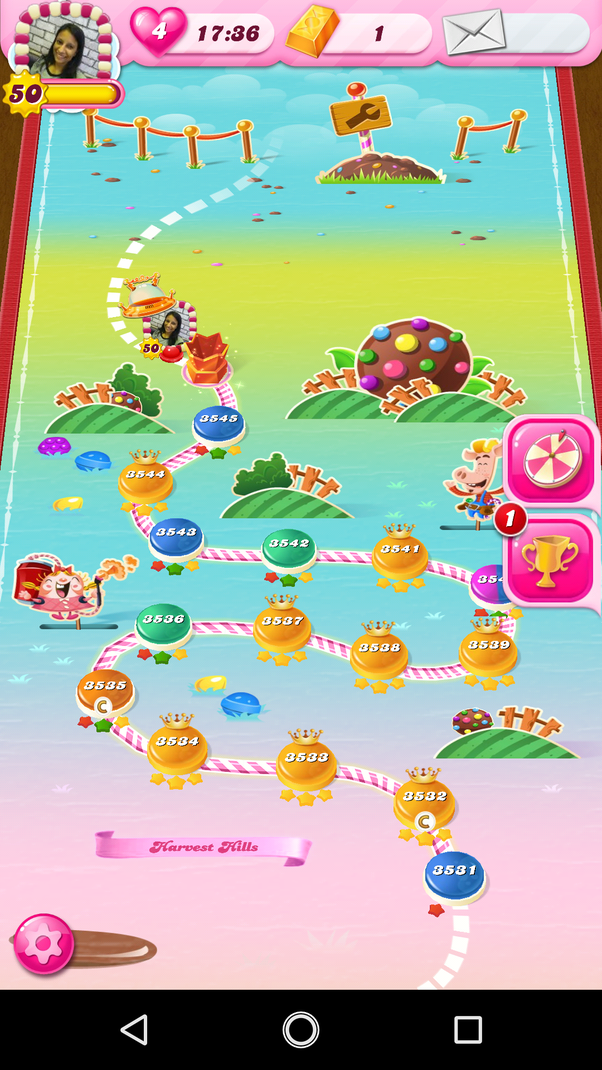
Getting over Stage 3000 (Candy Crush)
Is Level 3531 in one Puzzle Game the same as Level 156 in another Puzzle Game? Maybe not to the Player?
Achieving that Perfect Deck (Clash Royale)
If the Gameplay isn’t broke, why look for the same game?
Having the Best Heroes in the Galaxy (Star Wars: Galaxy of Heroes)
Similar Gameplay is often not enough to get players to leave themes that they love.
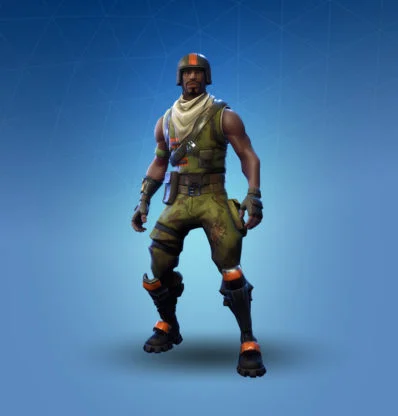
Showing off Skins others would die for (Fortnite)
It’ll usually take more than a clone to get people to give up the games they love.
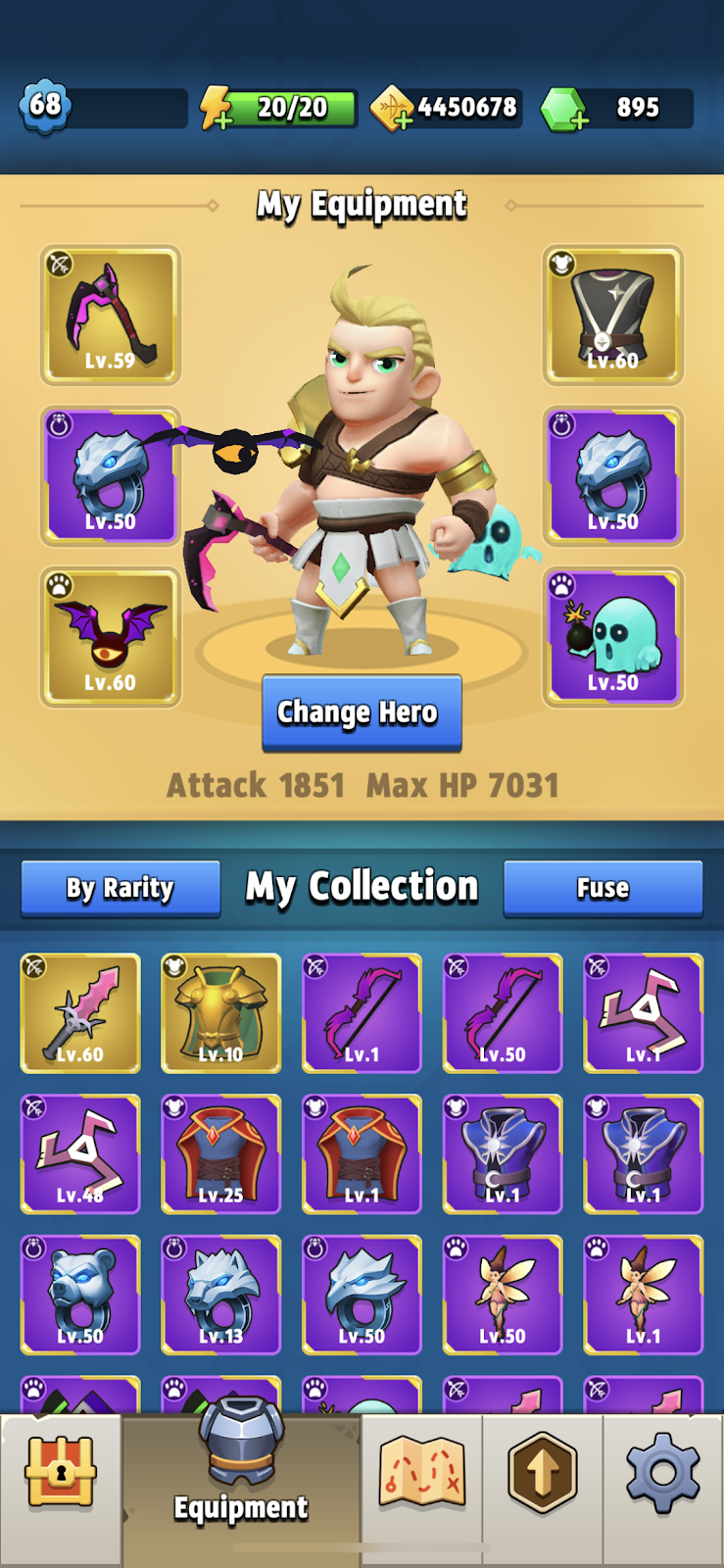
Optiizing your Hero in a Roguelite Game (Archero)
Starting from the beginning can be painful when you’ve spent years playing a game.
When your Alliance is one of the Best in the Kingdom (Rise of Kingdoms)
Its hard to leave when you are at the top of your Kingdom
All of these reasons are enough to explain why a Player sticks with the game they are playing for years (or over a decade when it comes to WoW). This is not to say that new games can’t cannibalize or steal away players from existing games. But it’ll take more than just competition to pry Players from the games they love.
Next week I will go over reasons why Players DO decide to leave the games they love playing. Thanks again for reading! You can find more of my posts in the ggDigest Newsletter. Subscribe to it at medium.com/ggdigest. Until next time, and stay safe!
What is Energy? The question seems easy and straightforward on it’s face. Energy is that bar we see deplete while we perform actions in the games we enjoy. But at its core, Energy is a limiting mechanic to both limit how much progress a Player can make over time as well as put an artificial end to a Player’s game session. While not all F2P Games need energy, all F2P Games need a limiting mechanic.
Today i’ll cover some examples of how Energy is used, how Players can evaluate the Energy economies of various games, and some other interesting alternatives to energy.
Casual Games
Many Casual games have simplistic energy mechanics.
Puzzle Games use Lives as their Limiting Mechanic
Hearts in Gardenscapes is a good example. After 5 failures, the Player’s play session is effectively over unless the Player pays in some way.
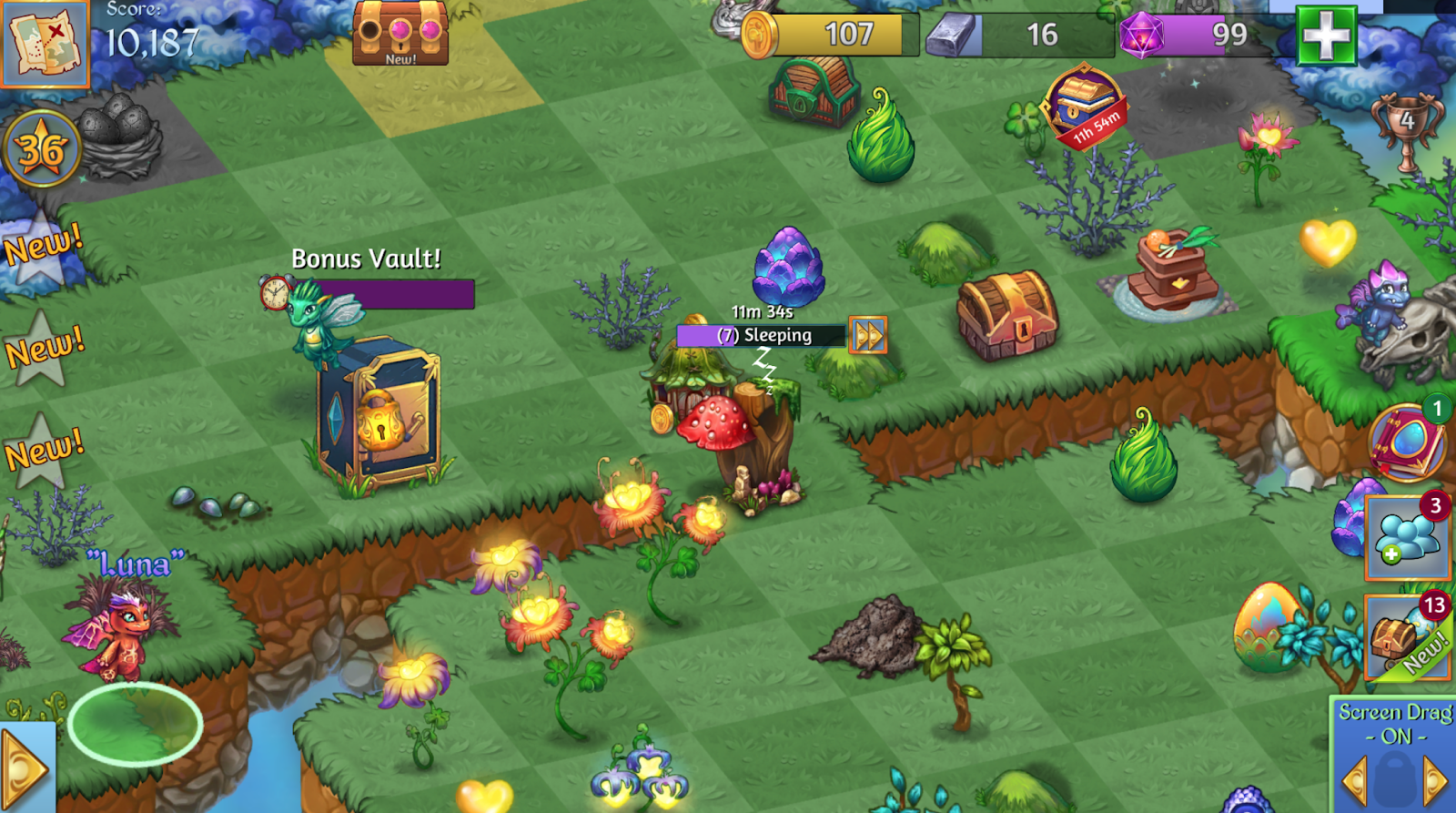
But not all casual games are that simple. Merge Dragons obfuscates the Energy Mechanic behind Dragons.
Merge Dragons hides their Limiting Mechanic in the form of Dragons
How Dragons work: A) Players earn/purchase Dragons and upgrade them; B) The Dragons begin doing actions to clean up the Player’s camp; and C) After doing a certain amount of actions, the Dragon will go into its home to sleep for several minutes. Just as you can break down minutes per action when it comes to Energy, you can also break down Minutes per action based on Dragon rest times.
The Cost and value of “Energy” (Dragons) in Merge Dragons is pretty easy for Players to figure out. The cost comes down to the amount of Dragons sleeping and how much longer they have left.
The cost of actions isn’t hard to calculate in Merge Dragons
The value of “Energy” (Dragons) is also simple–Wake a Dragon and get X amount of actions before it sleeps again. Players can do the math to see what the value of their dollar is worth.
RPGs
Players in RPGs are all-too-used to seeing Energy as a limiting Mechanic. Star Wars: Galaxy of Heroes, for example, requires energy for Players to do a PvE Stage.
Lots of RPGs use Energy as a mechanic.
Just like the casual games I’ve discussed, the cost/value proposition of Energy in Star Wars: Galaxy of Heroes is pretty easy to determine. Hard Currency cost of an Energy Refill is clear when you try to refill energy, and the potential drops of PvE Stages is also pretty clear based on what Stage you use the Energy in.
The Value Proposition of energy in SW: GoH is clear.
Contrast this with an RPG like RAID:Shadow Legends, where Energy is necessary for almost every Event, and the value proposition of Energy becomes a lot harder to assess.
Energy can get you a lot of things from more than just the PvE Stage.
For when you spend Energy in RAID, you aren’t just getting the immediate rewards of the PvE content you are playing (like you do in SW: GOH), you are also making progress on a wide variety of Events and other systems like Battle Pass, Daily Quests, Missions, etc. When you factor the rewards of Events/Other Systems, it becomes difficult to know how much value you are getting from Energy except that you are getting more than what the Game tells you at first glance.
Combine this with RAID’s Energy-oriented Packs, and you get a scenario where Energy is super cheap and the value proposition is better than expected.
What a deal!
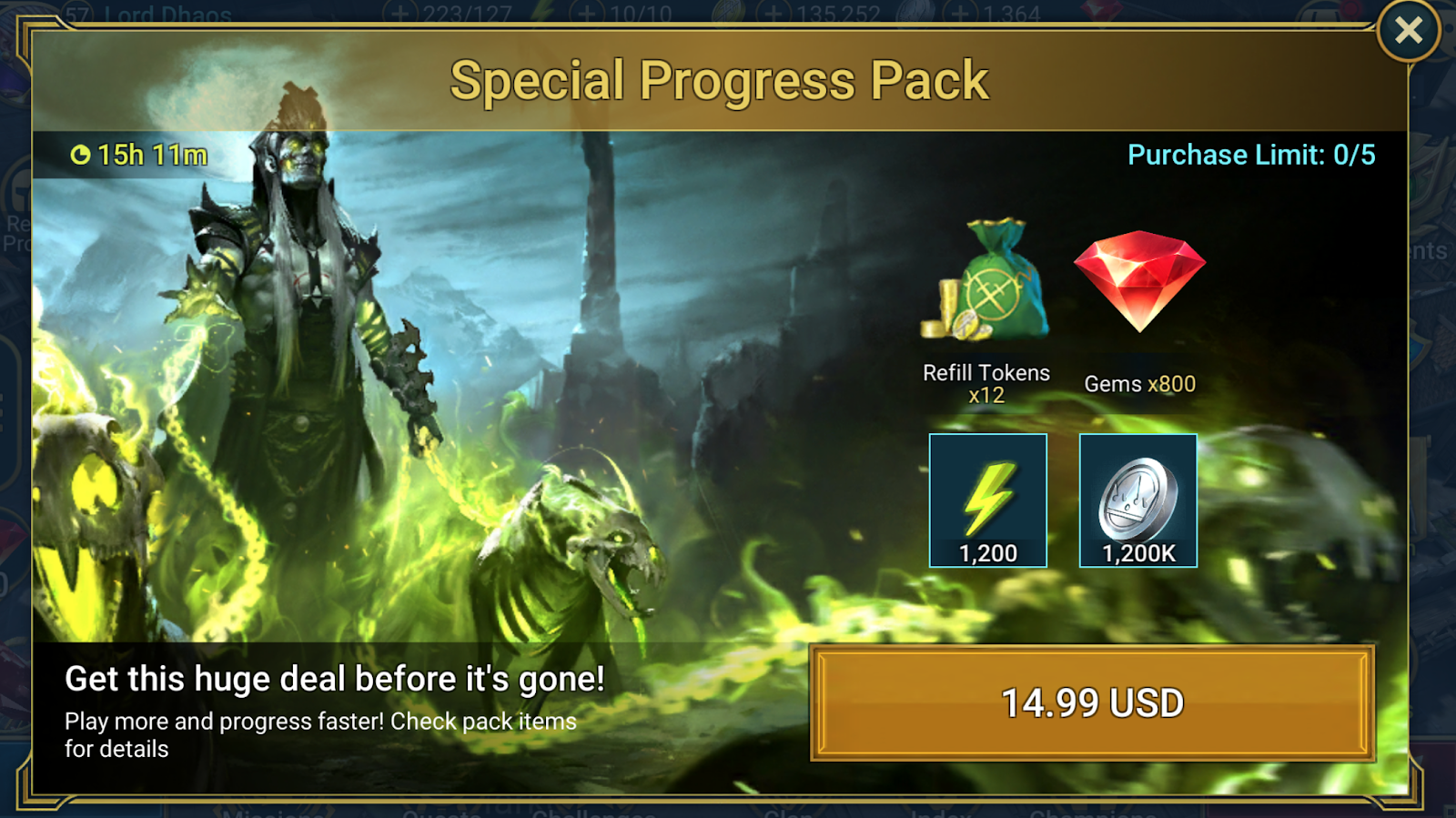
In this example of an Energy Pack, Players can get anywhere between 2620 Energy to 3800 Energy for $15. That Energy can go a long way and accomplish a TON. Compared with other Packs, the Energy Pack gives more bang for your buck as long as you have the time to spend all the Energy.
Strategy Games
Strategy Games typically don’t have Energy in the traditional sense. But they almost all have a limiting mechanic.
Clash Royale uses Chests to limit how much a Player can play without Spending.
Once all 4 chests slots are filled, your session is Clash Royale is done.
Clash of Clans uses Army Troop Training Times and Hero Health Recovery Time to also Limit Player Gameplay.
Clash of Clans stops you from playing if all your troops are dead and need to be retrained.
Even 4x Games like Rise of Kingdoms uses travel times and army caps as a means of ensuring that Players cannot endlessly send off Armies without paying a cost.
Army Cap and Travel Times are limiters in Rise of Kingdoms
Almost all games will have a Limiting Mechanic similar to Energy, if not Energy outright. If you are thinking about paying to get around the Limiting Mechanic (or purchase more Energy), make sure you get the most value for your dollar.
That’s it for me. Thank you for reading! Feel free to leave a comment or question. If you want to see more posts like this, please subscribe to ggDigest here: medium.com/ggdigest
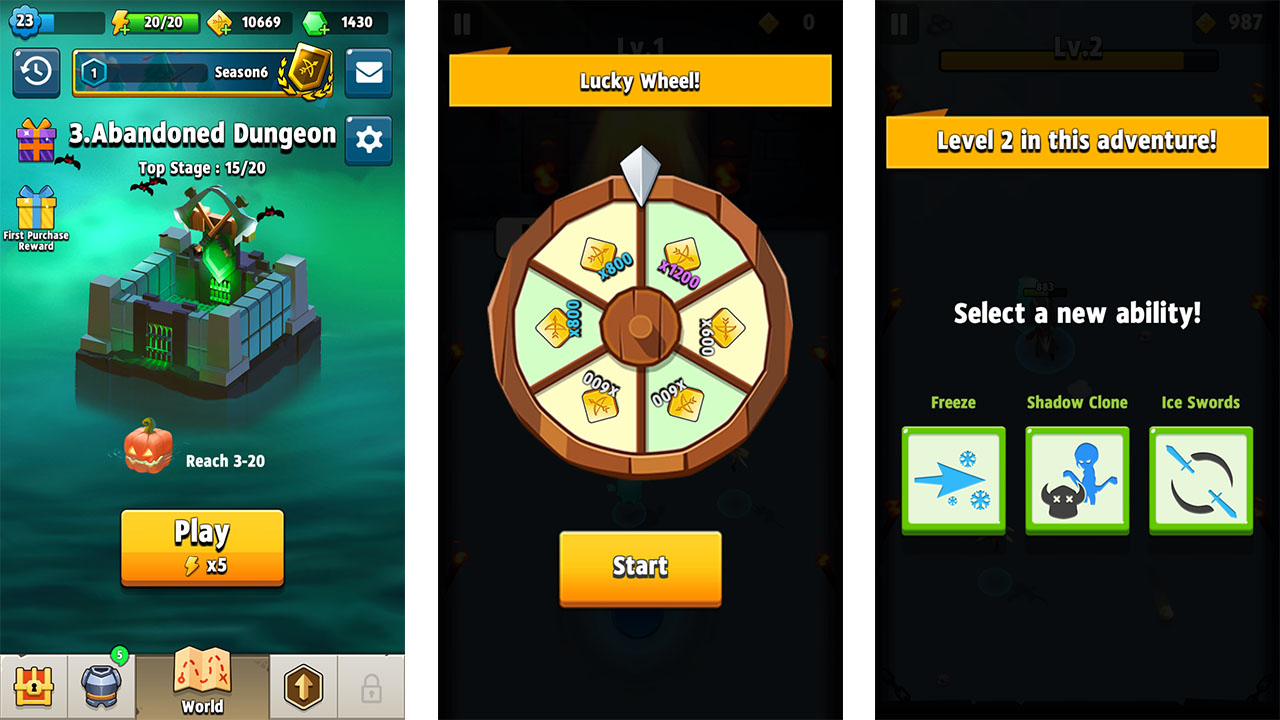
Timing is everything it seems. In my last post about Metasystems in Roguelite Games, I suggested that Archero and other Roguelite Games with Heroes could do a Gameplay Mode that allowed Players to use all their Heroes. A few readers were quick to point out soon after my post went public that Archero released a similar feature as what I had described 1-2 weeks earlier. So this week I took a look at Archero’s implementation, and provided my own design analysis to it.
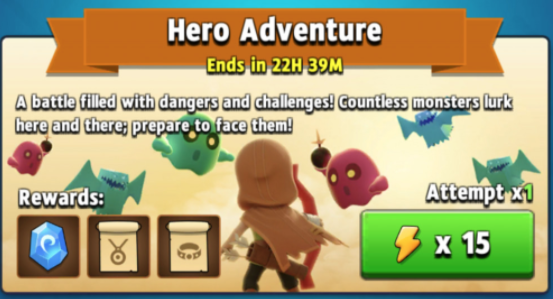
Archero’s Hero Adventure Event is an example of designing a feature without purpose. If Engagement/Retention was the ultimate aim, then the Hero Adventure Event seems superfluous because there is enough in the game already to keep Players engaged. If the intent of the Hero Adventure Event is to boost monetization, then the design of the Hero Adventure Event missed the mark in almost every single way.
What is the Hero Adventure Event? It’s quite simple actually:
For 15 Energy and 1 Attempt, the Player enters an endless dungeon mode.
Stages start out very easy but increase in difficulty over time
The Player can use a total of 3 Heroes. When one Hero dies, the Player chooses a 2nd Hero. When the 2nd Hero dies, the Player chooses a 3rd Hero.
The farther the player goes, the more rewards the Player receives.
While Players get 1 free attempt per Event, they can pay 100 Gems for a second shot.
That’s pretty much it. If this Event were just for Engagement, it might be fine as is. But Archero is not lacking in stuff to engage Players. In fact, a core aspect of Roguelite Games is that they generally don’t run out of content to engage Players with. So if the Hero Adventure Event wasn’t designed to improve Engagement/Retention, how does it perform as a Monetization Event?
When it comes to whether Events monetize, an Event must have two things:
It is not enough to have one or the other. An Event with proper Player Motivations but no or few opportunities to sink Hard Currency or push IAPs won’t monetize well mainly because there aren’t ways for Players to spend more to engage or excel in the Event. Conversely, an Event with a bunch of ways for Players to spend to succeed will flop if Players have no motivation to do better in the Event than they otherwise would. An Event needs both of these factors to succeed.
Here are the Opportunities that an Event such as this could use to sink Gems or boost IAPs:
Directly Sink Energy, Coins, or Gems as a requirement for Players to engage with Event.
Directly sink Gems, Coins, or push IAPs that give Players Event Boosts
Directly sink Gems or push IAPs that give Players Heroes or Equipment that excel in the Event
Indirectly push Players to invest in existing metasystems.
It is important to note that not all Opportunities for Monetization are compatible together. Let’s look at #1 and #4
#1: Directly Sink Energy, Coins, or Gems as a requirement for Players to engage with Event. #4: Indirectly push Players to invest in existing metasystems.
These two are at odds with each other because to invest in one comes at the opportunity cost of the other. The more Gems/IAPs I spend to engage with the Event more, the less I’m spending investing in existing Metasystems to do better per playthrough of the Event. This is a result of the duality of Skill vs. Stats.
We’ve always known that Skill has the potential to undermine the importance of Stats. It is also true that frequency of Attempts does the same thing. The more a Player can participate in an Event, the less Stats matter. This is because the marginal benefit of improved stats becomes more outweighed by the cumulative gains the Player gets by running the Event several times. Why pay for Stats so I can earn 15000 points in one go when I can pay much less for more Event Attempts and earn 30000 points in three goes? While it is true that the long-term benefit of Stat improvements will carry over from Event to Event, Players generally don’t respond well to long-term incentives when there are cheaper ways for better short-term payoffs.
While Archero allows for multiple attempts of the Hero Adventure Event, it can get costly. Purchases of additional attempts start at 100 Gems (the first Attempt is Free). But it almost doesn’t matter because there is nothing about the Hero Adventure Event that pushes Players to play the Event more or less often. There are no goals/milestones for Players to try and reach, nor is there a Leaderboard comparing the progress Players make. So even if the Hero Adventure Event is well-positioned to sink Gems for additional Attempts, there is no reason for Players to do so unless they want the Grinding rewards that badly.
Since the Hero Adventure Event does put a premium on repeat Attempts, it is primed to be able to capitalize off of Stats. In general, the fewer attempts a Player has at something, the more important stats that help the Player complete that something are. For Events that want to achieve #4 for Monetization (Indirectly push Players to invest in existing metasystems), limiting attempts is Key.
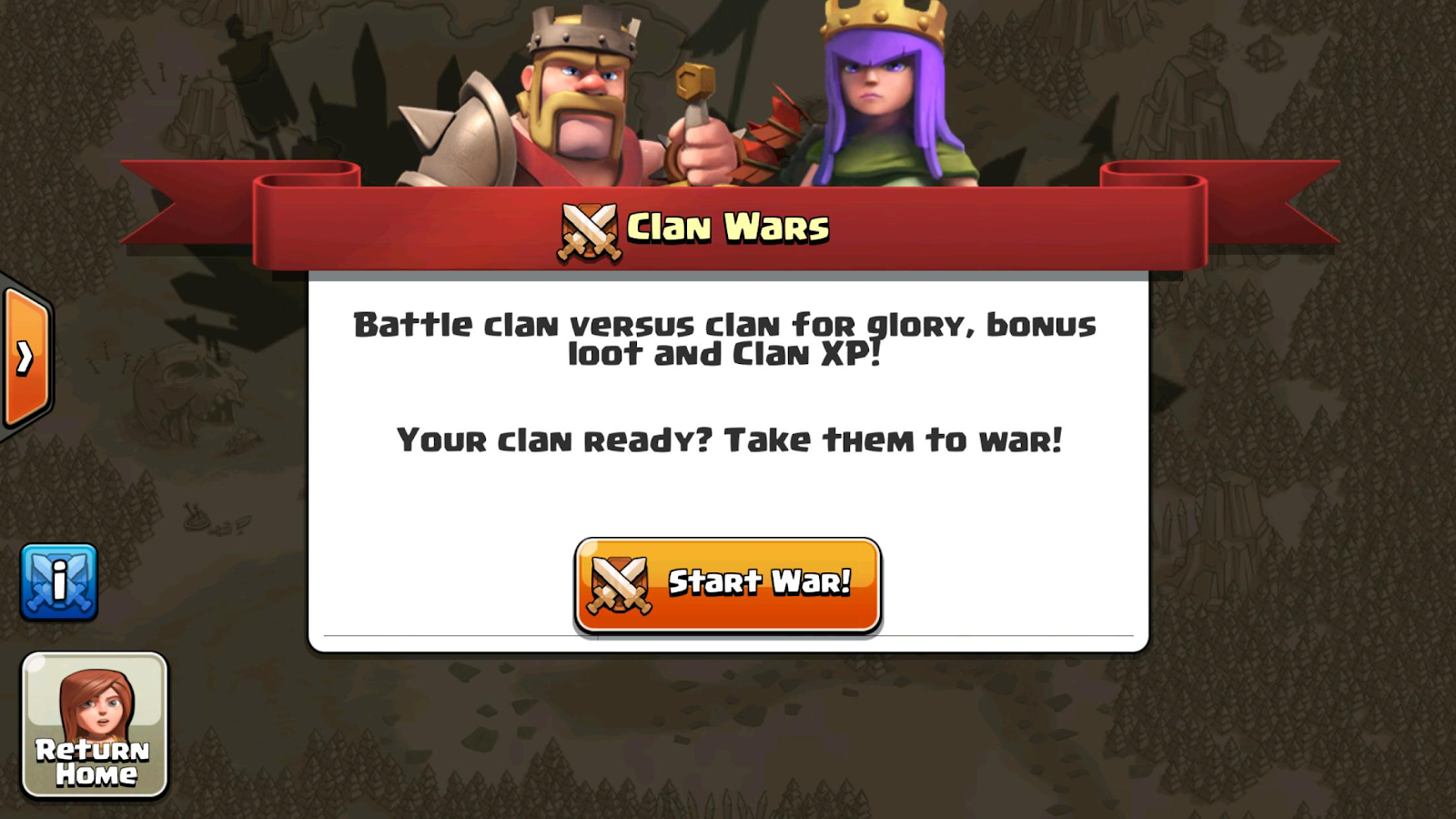
Take Clan Wars in Clash of Clans. During the Clan War, each Player only gets 2 Attack Total. There is no way to pay for more Attacks. Because of this, the social pressure to win both attacks will motivate Spenders to invest in upgrades so that they have the highest chance of winning. Were Supercell willing to sell additional Attacks for Gems/IAPs, there would be much less incentive for Players to make sure their Base and their Heroes/Units are top notch.
Archero’s Hero Adventure Event goes in this direction somewhat. Allowing the Player to use 3 Heroes gives the Player a reason to have 3 high level Heroes. But why only 3 Heroes? Why not all Heroes? If the Hero Adventure Event has “endless” levels, there is no risk of Players reaching the last level too easily. And if one is concerned that Players won’t have enough time to play through with all their Heroes, why not extend the Event to last longer? 3 Days? A Week? Players will be be incentivized to invest in their Heroes regardless of the Event duration so long as they have proper motivation to do well in the Event. But do they?
This brings us to Common Player Motivations in Events:
Social Pressure: My Guild relies on me to do well
Metasystem Progression: Doing well in the Event will make me a lot better than other types of Gameplay
Competition: I want to be the Best and I want other players to know that.
The Hero Adventure Event has none of these motivations. There isn’t a Guild/Clan system, so there isn’t really pushing Players outside of their individual motivations. A Leaderboard would allow Players to indirectly compete against one another through performance in the Hero Adventure Event. Does Archero have one? Nope.
The Rewards have to be special or very lucrative if you want to motivate Players.
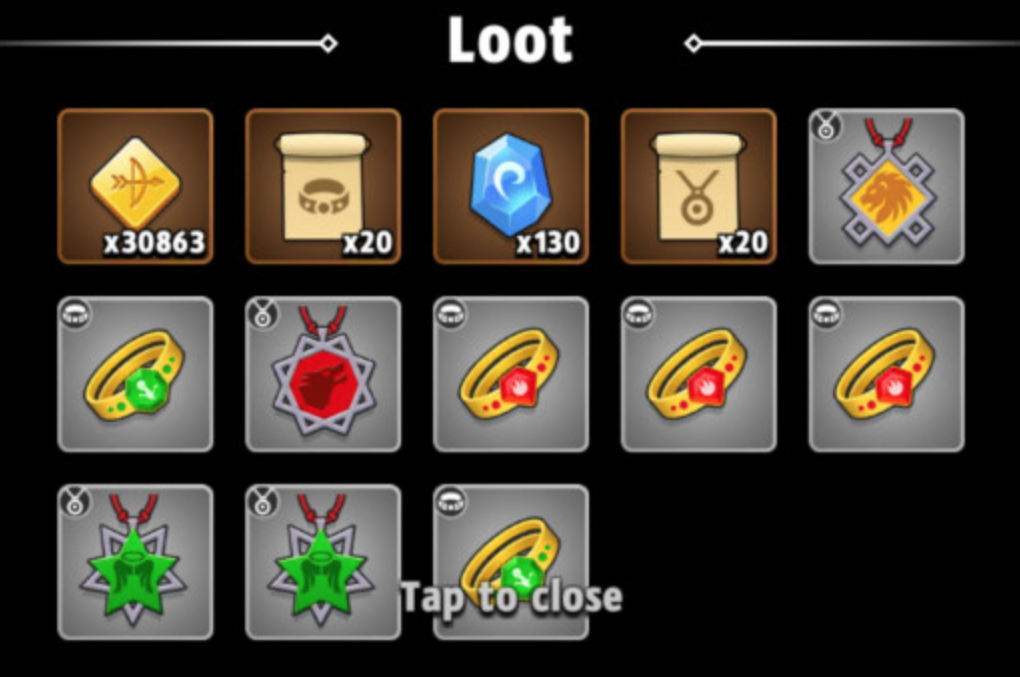
Finally, do the rewards that the Event offers incentivize Players to spend tons of Gems to upgrade their Heroes and Equipment? No. The rewards are comparable to if the Player had spent the time and energy grinding the other content. While there is slightly better access to rings and amulet equipment, that itself doesn’t seem enough to spur Players to invest more in their Heroes and engage more with the Event.
At this point, i’ll stop critiquing and start offering design ideas of my own. As a Game Designer, it’s so easy to point out flaws in others’ designs. It’s harder to offer up specific solutions. So here is how I would redesign the Hero Adventure Event:
Stretch the Event out to a Week and allow the Player to use all their Heroes
I do this for a number of reasons. First and foremost, I would give all Players only one playthrough. They only got one shot at this Event, and so the Player will have to rely on both their Skill and their Stats to succeed.
While I wouldn’t sell additional attempts at the Event, I might allow players to “retry” it if they have the Battle Pass active. If their new Event score is higher than their first attempt, they’ll go with the second score. If it’s lower, the first score stands. But they could only do this a finite amount of times (probably only 1 repeat attempt). This retry is more about boosting the appeal of Battle Pass than it is about monetizing off of the Hero Adventure Event.
Add in both Milestones and a Leaderboard with Unique/Valuable prizes.
The Leaderboard would be based on points earned from completing Stages in the Endless Gameplay mode that the Hero Adventure Event currently has. Progress in the Leaderboard would be based on points earned in the Endless Gameplay Mode. (Stage 1 completed = 1 point, Stage 2 = 2 points, etc.). I would add in a 2x point multiplier for the points from a Stage if the Hero doesn’t get damaged in that Stage. Players with the highest scores on the Leaderboard get the best prizes.
Speaking of Prizes, I would err on the side of Unique, Hero-specific Equipment that is generally better than the generic equipment that all Heroes wear. Because it is Hero-specific, the equipment can be stronger and have more unique bonuses than what Equipment normally has. And these Hero Adventure Events would be the only way a Player can earn such Equipment. I would also try to come up with social rewards that Players can have that allows them to show off to other Players.
I wouldn’t make Milestones based on points earned, but rather on Stages reached (10, 25, 50, 75, 100, 125, 150, 175, 200, etc.). These rewards might also have Hero-Specific Equipment, but would more likely have just a ton of coins, regular equipment, etc. The rewards would have to be high enough to make reaching these Milestones more lucrative than normal grinding. If I was worried about too much inflation, I would make the cost structure of upgrading Hero-specific Equipment sink most or all of the excess Milestone Rewards.
Organize these events around Seasons or some other regular Time Frame
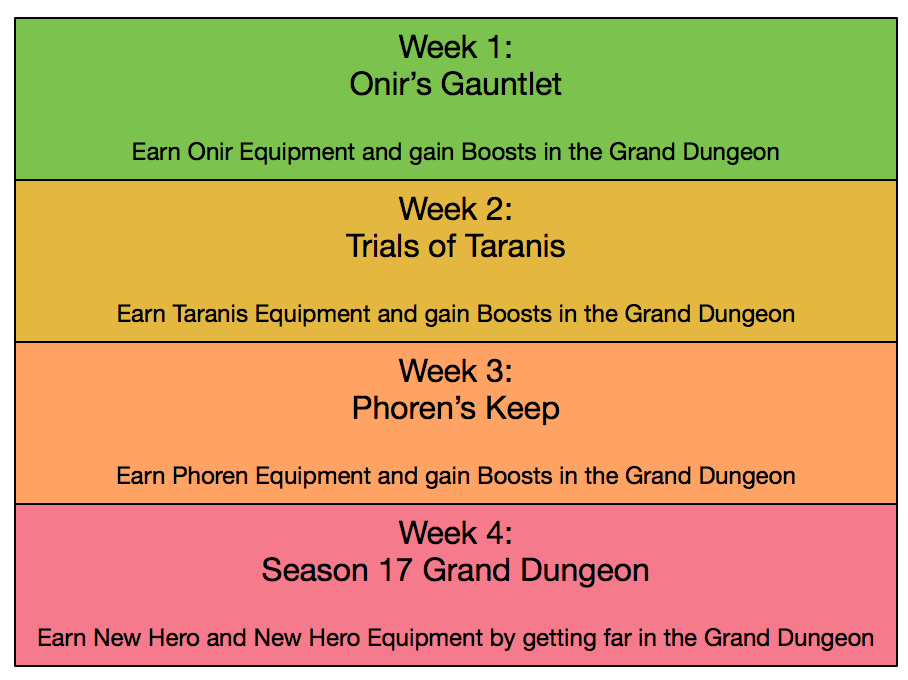
I would organize these Events around both a Season and a new Hero. If a Season is 4 weeks, then the first 3 Events would each focus on a specific existing Hero. Each week’s Hero Adventure Event would give a specific Hero’s equipment (as well as allow Free Players to unlock these Heroes if they don’t want to spend). Each of these Events can have special rules, like Ground Monsters do more damage, or Flying monsters take less damage, etc. The Rules are important since they shake up the Gameplay (and thereby undermine a Player’s skill). These 3 Events would also give bonuses for the Fourth, final Grand Dungeon.
Archero already has Seasons. Why not connect events to the Season?
Performance in the Grand Dungeon can earn the Player the new Hero if they complete the Milestones, and new Hero equipment if they rank high in the Leaderboard. For Players who played through the Events of Weeks 1-3, they’ll be primed to do well in the Grand Dungeon.
That is what I would do to the Hero Adventure Event if I wanted it to perform better on Monetization. But this is not the only way to do it. I view Game Design as fairly relative, and as long as an Event has the proper opportunities for Monetization as well as gives the Player proper motivations, it should do well as a Monetization Event.
Thanks again for reading. Feel free to leave comments or if you have any thoughts yourself. I apologize for the huge blocks of text. The Hero Adventure Event is fairly simplistic and doesn’t offer a lot in terms of important screenshots. If you liked my post, check out more of my posts on ggDigest. Subscribe at medium.com/ggdigest. In the meantime, stay safe everyone!
Making sure Players don’t run out of content is a huge issue that Game Developers across PC, Console, and Mobile have. Developers of Roguelite Games seem to have largely mitigated this content issue by having procedurally generated content as their core gameplay. But while the problem of gameplay content seems to have been solved, many Roguelite Games either neglect or under-develop their Metasystems. Because of the RPG-nature of many Roguelite Games (Turnbased, Action, or otherwise), Game Developers can not only monetize the games better by incorporating deeper, more meaningful Metasystems, but they can also give more direction and purpose to the Gameplay grind.
One important aspect of good game design is the idea that a player should make progress in every meaningful play session. This means that when the Player has engaged with the core loops in the way the developer has intended, they should be better off than when they first began. Some Roguelite games accomplish this. In Archero, Players will receive gold when they first enter the Stage at Level 1.
The farther along they get in that Stage, the more gold they can earn along with equipment scrolls, equipment, etc. But the point is that no matter how far they get along, Players will walk away with a minimum of Gold by spending that Energy. Note that Archero uses an Energy mechanic whereas a lot of other Roguelite Games don’t. Because of the Energy Mechanic, Archero can afford to give away Gold at Level 1 and not worry about abuse.
Other Roguelite Games are not so generous.
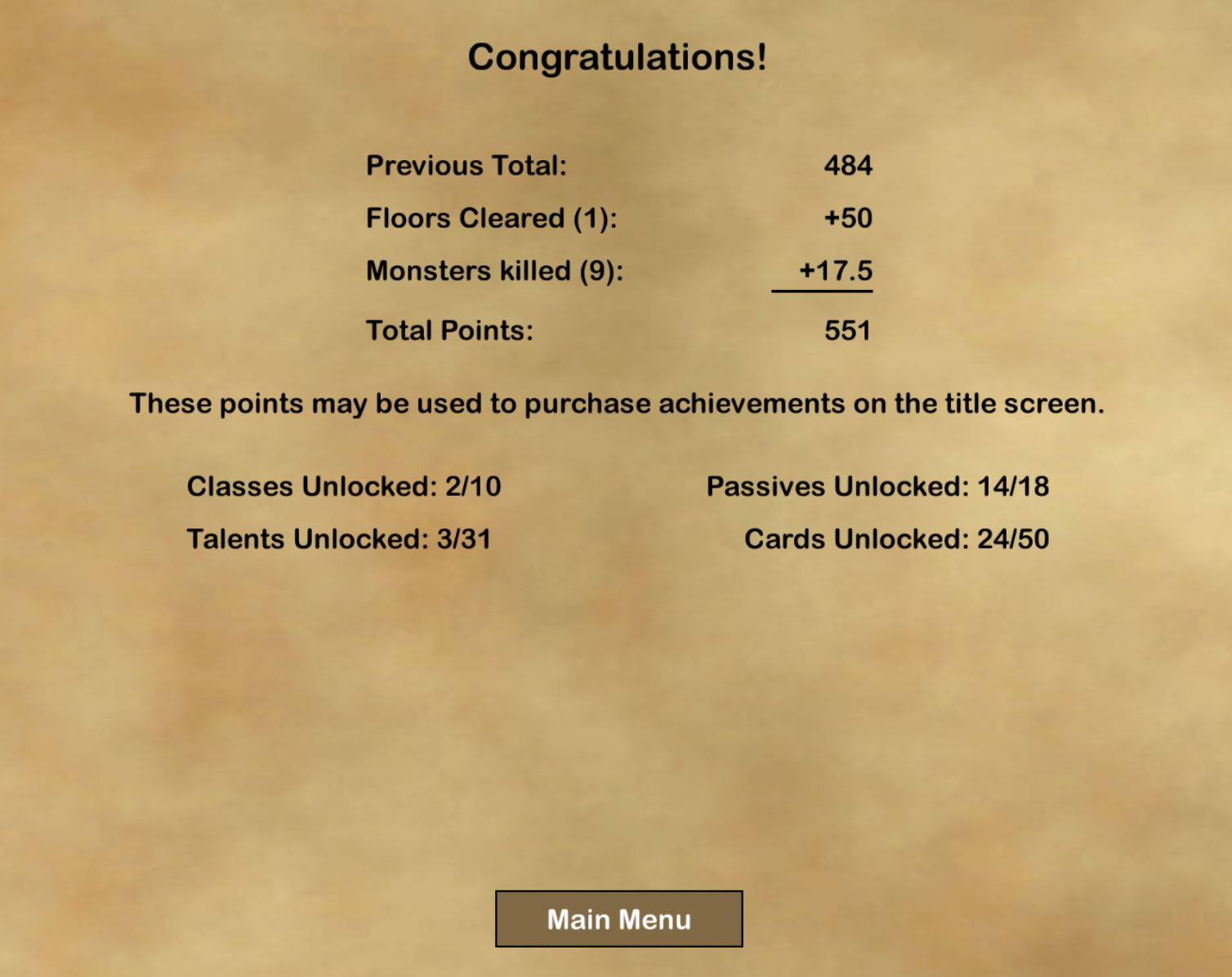
In Dream Quest, Players can unlock available Cards for Classes and improve their initial conditions through Achievements. But the problem is that it may take Players a lot of playthroughs before completing an achievement. In many cases, losing a playthrough will get players this:
Points are useful for revives, but as a Player I don’t feel as though i’ve made any meaningful progress in the game.
Given that many Roguelite Games are RPGs of some sort, its curious why companies haven’t pushed more on the Metasystem design. One aspect of RPGs is that its pretty inexpensive to expand content for Elder Game players, at least balance-wise. For Roguelite Games especially, if a Developer is worried about Players getting too strong, the easy solution is to create later levels with stronger enemies to challenge those strong Players. Because of this, Roguelite Games should push on the design of their RPG Metasystems. Notably, the following things can be improved on:
Deeper Systems per Hero
Everything systems you find in RPGs across F2P Mobile and PC/Console is fair game to be used in Roguelite Games, including:
Hero Equipment (Like WoW Equipment)
RNG Systems (like Runes in Summoners War)
Every RPG should have an RNG system.
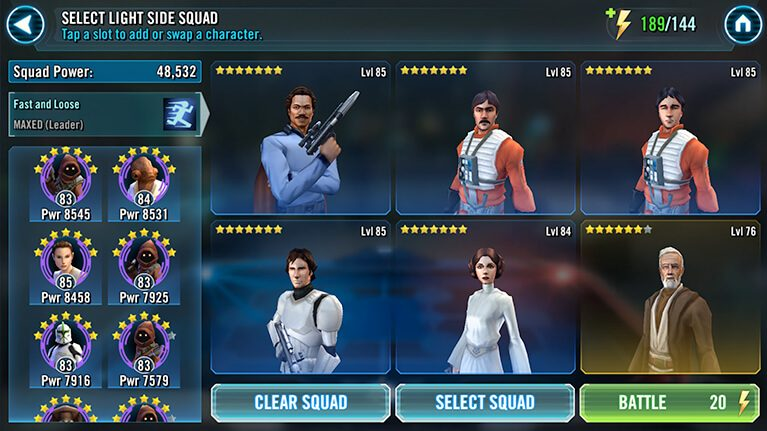
Hero Tiers (Like Star Wars: Galaxy of Heroes)
Hero Tiers seem like a no-brainer.
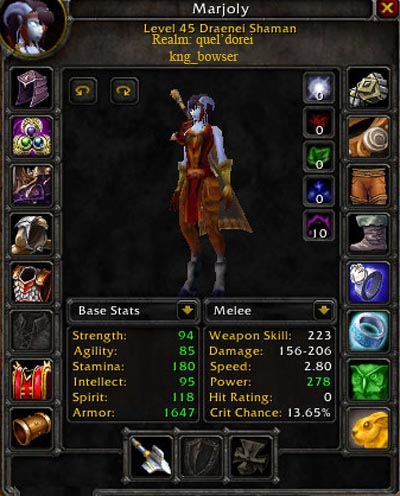
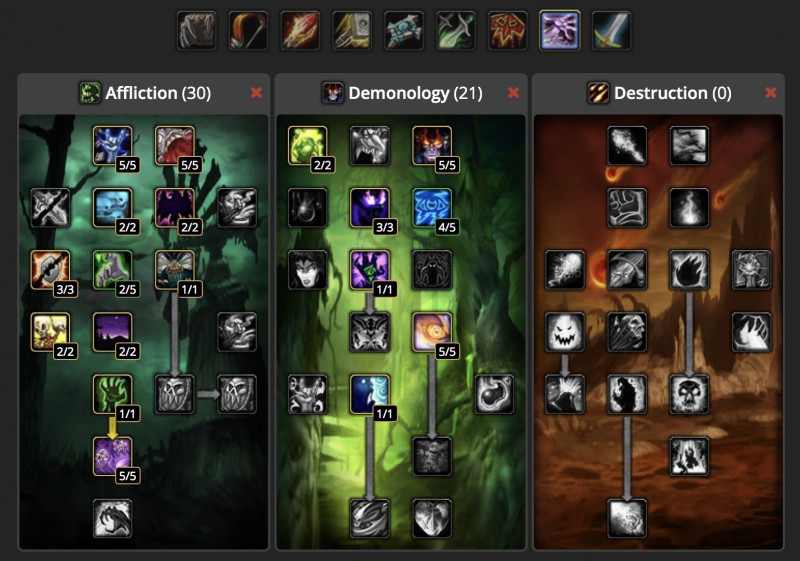
Talent Trees (from WoW)
Way more impressive than Archero’s Talent System
The List goes on….
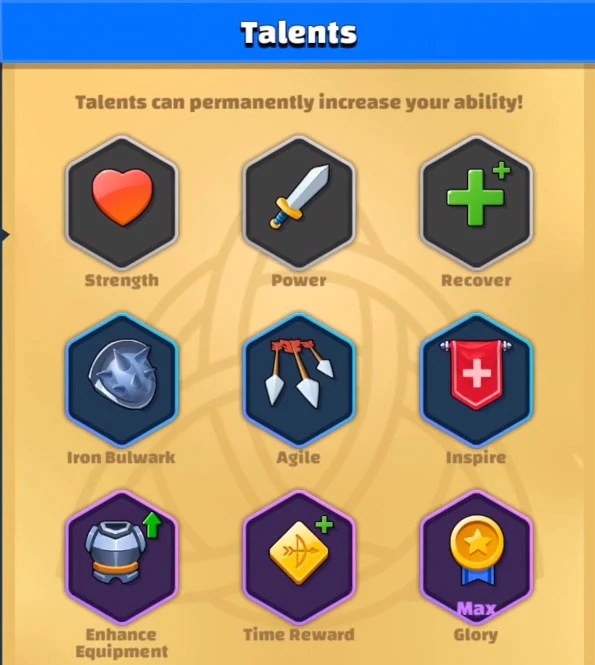
This is not to say that no Roguelite Games are implementing some of these features. Archero has talents.
Doesn’t quite have the grandeur of WoW.
Archero also has a rather basic equipment system too.
If you wanted to develop an equipment system that would last 5 years, this is too shallow.
You might argue that the audience for Roguelite Games is too casual for deeper, more complicated Metasystems. Not only is there little evidence that the audience will reject more complex systems, that risk is more than outweighed by the risk of running out of content. Archer had to introduce a 7th Equipment rarity because getting to Rarity 6 was too easy.
For the long-term health of your game, its always better to err on the side of more depth rather than more simplicity.
More Heroes and Hero Management
All depth effect of all these complex Hero Systems is multiplied by the number of Heroes that a Player needs to use to optimize their progression in the game. While many RPGs utilize parties of 3-5, Roguelite Games typically will have players play 1 Hero at a time. This is not to say Roguelite Games don’t have multiple Heroes–Dream Quest, Slay the Spire, and Archero all have multiple Heroes. But the incentive to use and optimize multiple Heroes is thin. Archero arguably does the best by giving objective stat-gains for specific Hero collection and investment.
The influence of Tencent here is clear.
It’s surprising to me that more Roguelite Games don’t deviate from the 1 Hero format. While having more than one Hero might be difficult for Action RPGs like Archero, I don’t see why a multi-Hero gameplay format can’t work in Turn-Based gameplay. The combat in Dream Quest, for example, can support multiple Heroes with a significant UI change.
But even if the Gameplay can’t support using multiple Heroes at once, there are systems you can use to achieve similar effects. For example, a Roguelite game can implement an event like that of the Arcane Labrynth in AFK Arena, where a Player can use all their Heroes, but health between Stages is persistent and a Player can only go as far as ALL of their Heroes will take them.
These Persistent Health Systems are great for encouraging investment in multiple heroes.
Something like that would work well for Roguelite games.
Stat-Based Gameplay doesn’t have to be Spender-Oriented.
Some people won’t like pushing Roguelite Systems deeper into RPG territory as it may make the games favor Spenders more than non-spenders more than if the gameplay was more skill-oriented. My simple answer is that a Stat-Based system is as Pay to Win as you want to make it. You could implement a super-deep stat system, and just be very generous with rewarding players so that spenders don’t have a huge advantage. Or you remove monetization off of stats altogether and focus monetization on gameplay (energy, keys, gameplay tokens, etc.). There are a lot of possibilities. The only concern in writing this article is that I felt that Roguelite Games could be improved if they had Metasystems that both directed the Player more as well as gave them a greater sense of Progression in an otherwise largely random Gameplay experience.
That’s it for me. Thank you for reading! If you want to see more Game Design posts from me, please subscribe to ggDigest here: medium.com/ggdigest
As we continue to live with Shelter in Place and look for Games with long playability at a low cost, Idle Games may not be the obvious choice. After all, Idle Games have the reputation of playing itself while we focus on our busy lives. Players return to an Idle Game hours after being at work, hanging out with friends, or doing some other activity, and earning a lot of resources they then invest to make more progress. Yet, there are ways to play Idle Games that keep you actively engaged over a long period of time and don’t cost a dime. From active tapping, to Ad Hunting, to early Prestiging, Idle Games can be actively enjoyed as long as one desires.
Active Tapping Extends Gameplay Length
At first glance, Active Tapping seems rather simple. It is usually that early part of an Idle Game where you tap to earn enough resources to upgrade to automatic resource production. Nothing stops players from continuing to tap to get resources, though the economics of endless tapping isn’t worth the inevitable carpal tunnel you would get if you did it all the time. However, some Idle Games have skills that boost resources you get from Active Tapping for a short period of time.
If you enjoy active tapping, utilize special skills that reward active tapping.
Using these skills and actively tapping for 10-30 seconds at a time is a good way continue playing the Idle Game by actively tapping in reasonable amounts while still making meaningful progress.
But active tapping also involves the investing of those resources to upgrade production. Idle Games typically offer Players options of how to upgrade ranging from one upgrade at a time to as many upgrades as you can afford with the resources you have. Idle Games give Players these options so as to accommodate a Player’s time (or lack thereof). And in normal times, Players may find themselves selecting the more expeditious upgrade options, like “100x” or “MAX.”
Idle Games offer various Upgrade Options depending on how much time you have to play
But if your goal is to stay engaged with an Idle Game to kill time, keeping the upgrade options at 1x or 10x will make your whole experience last longer.
Speaking of upgrades as Active Tapping, most upgrades take place in the first moments of a Prestige Cycle. This leads to…
Prestige Early and Often to Extend Active Tapping
Because there is a burst of activity in an Idle Game after every Prestige Reset, Players looking to extend their active gameplay should look to Prestige earlier than they otherwise would.
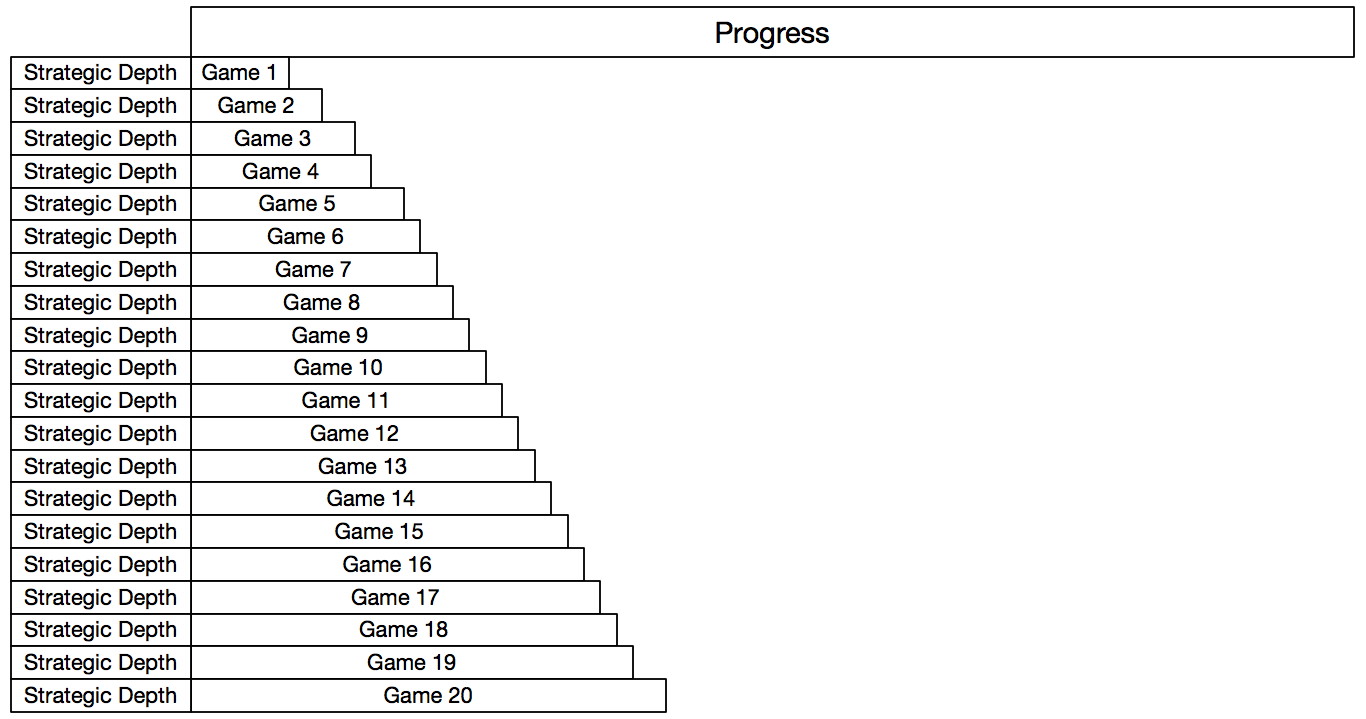
In normal times, each Prestige would allow the Player to progress more than in past Prestige Cycles. As such, Players tend to spend more time in later Prestiges than they do in earlier ones.
The more Prestige Cycles you play through, the deeper you typically will go in the Economy.
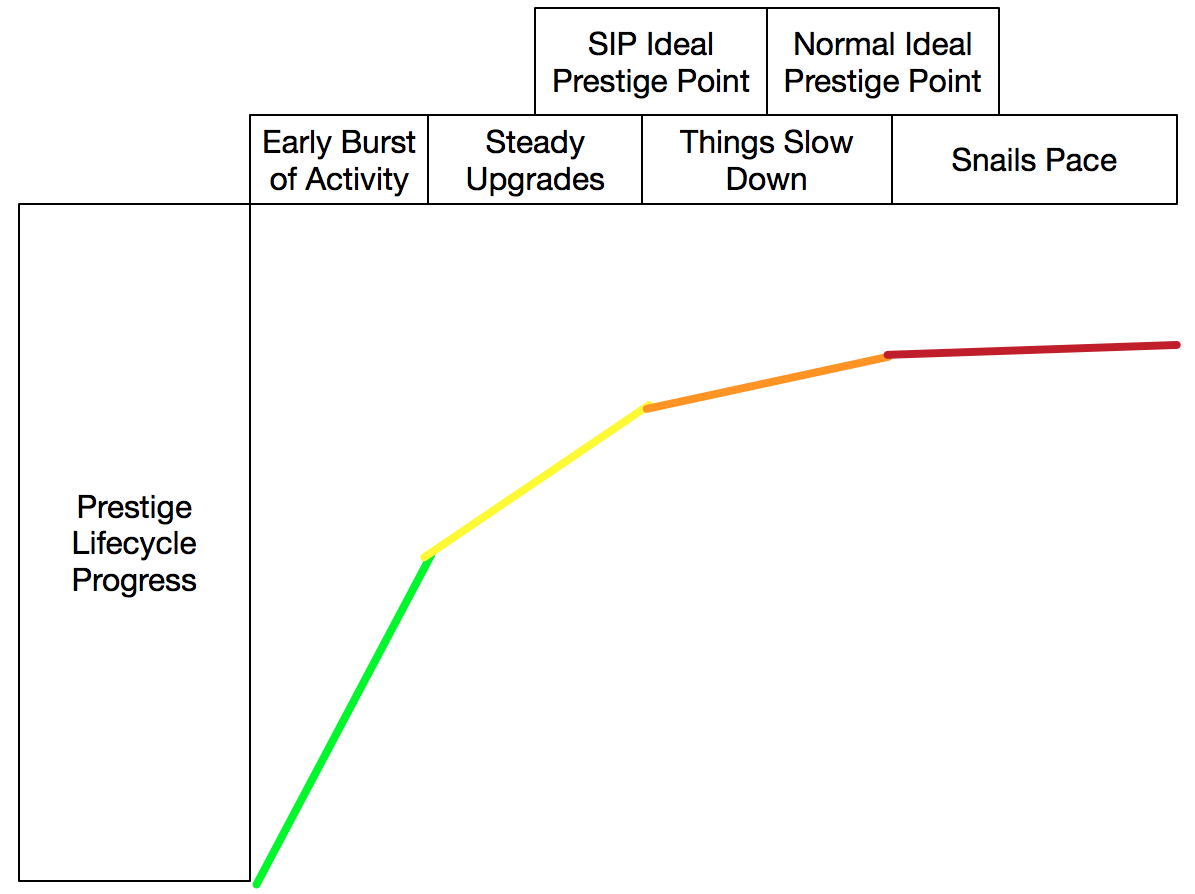
There are typically four stages in a Prestige Lifecycle:
Burst of Activity: When a Player prestiges and begins a new Lifecycle, there is a ton of activity to do. Players typically are able to do more upgrades than they have time to tap, so tapping for all the Upgrades can take a long time. The more progress the Player has achieved in the Idle Game, the longer this Burst of Activity stage will last after prestiging.
Steady Activity: After the Burst of Activity is over, and the Player has all the upgrades under control, there is a period of time where the Player will continue to make upgrades at a steady pace (i.e. every time they log in). Even Players who are actively playing will find themselves continuing to upgrade without much time in between.
Things Slow Down: After enough time and Progress made, Players will begin to find that upgrades become fewer and farther between. It is at this point that Players will normally begin considering Prestiging. How long a Player continues to play in this Prestige Cycle depends on how much Progress they want to squeeze out of it. Players stay in this stage until they no longer make any meaningful upgrades.
Snail’s Pace: At some point, Players will get to a point in the game where they aren’t making many upgrades, and the ones they are making aren’t meaningful. By meaningful upgrade, I mean an upgrade where the Player gets a big bounce in productivity. This typically happens at Level intervals of 10, 25, 50, 100, etc. At some point, upgrades become so costly that Players will no longer be able to hit these Milestones without days worth of resources. At this point, its not longer worth playing this Prestige Cycle.
Prestige earlier than usual if you want extended active gameplay.
Now typically Players will start to think about Prestiging once they hit Stage 3: Things Slow Down. Impatient Players may Prestige early in that Stage, while more patient Players will try to achieve that last bit of meaningful Progress. Other considerations like does a Player have time to do the Early Burst of Activity Stage may influence when they decide to Prestige.
But in this SIP period, Players looking to get more gameplay out of their Idle Game are encouraged to Prestige earlier. Basically when the Steady Upgrades stop coming, it might be a good time to Prestige. You’ll find yourself spending more time tapping during the Early Burst of Activity, and you’ll be more engaged overall.
Finally, Ads are a Great way to Boost Progress
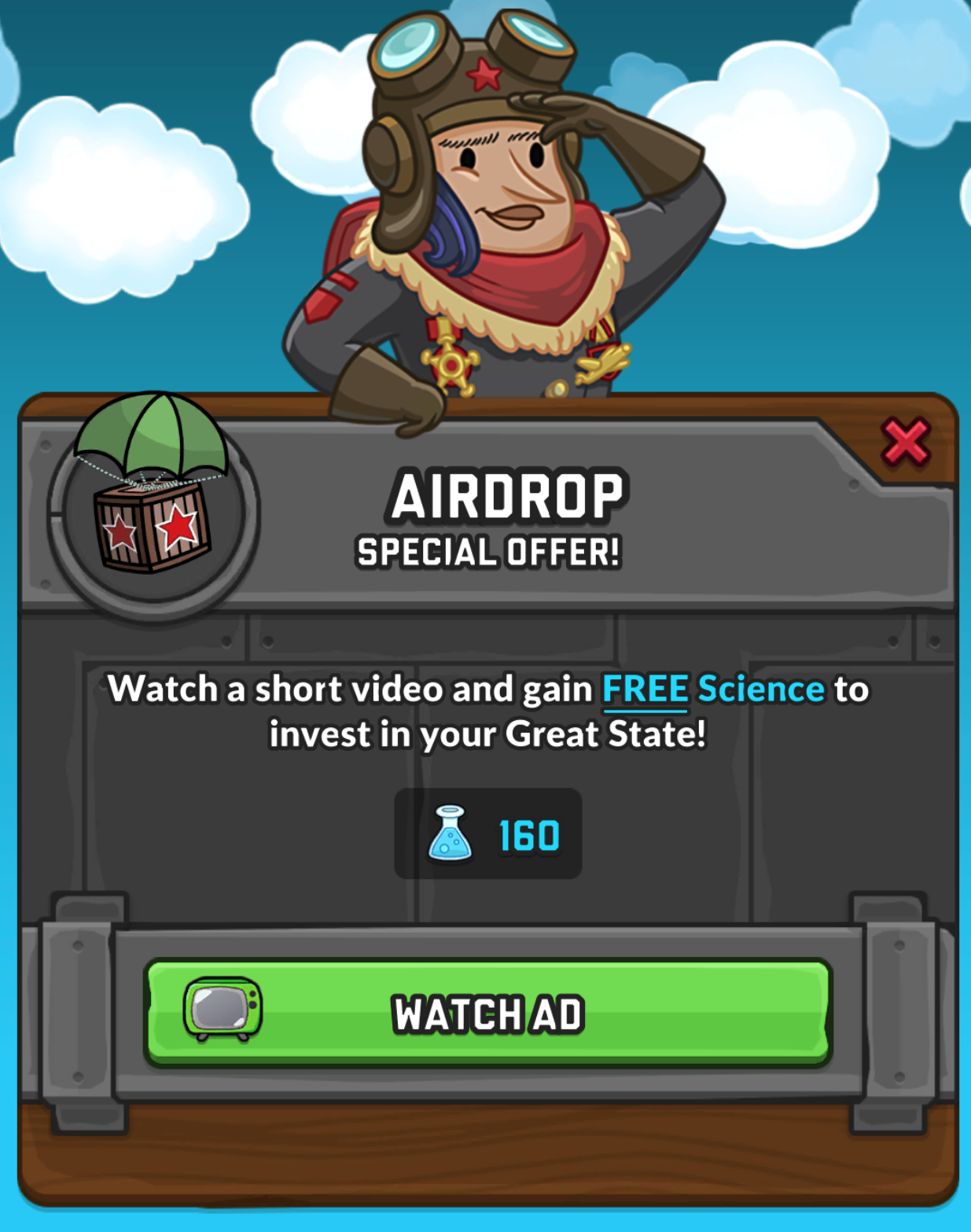
Anyone familiar with Idle Games knows that Ads are a large part of the game. If you are continually playing an Idle Game and NOT watching Ads, you are doing it wrong. The benefits Players get from Ads can be a MASSIVE Boost to their game.
Ads can get you some valuable Resources
And as Players play Idle Games longer, they’ll have more opportunities to take advantage of the occasional Ads that pop up.
That’s it for me. If you like this article and want to read more posts like these, as well as other interesting articles about the Game Industry, check out ggDigest, the best gaming industry newletter out there. Subscribe now at ggDigest.com.
Thanks for reading, and I hope everyone stays safe and stays entertained as we continue to Shelter in Place.
Time is a hard concept to wrap your head around in games. At its simplest, Time is cast times, cooldowns, crop grow rates and when you get your next heart for a Match3 Puzzle game. But Time is also super important to think about when designing the player experience, or figuring out how to exchange Time for money in sales. Free to Play Games normally allow Spenders to spend money in exchange of time spent grinding. This has been a mainstay of Free to Play Games in a world where we all have jobs to go to, friends to hang out with, errands to run, etc.
But as we Shelter in Place for the foreseeable future in response to the Coronavirus outbreak, we suddenly find ourselves with more time than we know what to do with. Games as a form of entertainment is an obvious choice to occupy some of that time. But given that typical Free to Play Monetization Strategies are built around Players having a scarcity of time, what should Game Developers do when Players have an excess amount of time to play their games? Similarly, what should Players look for in a Game to get tons of entertainment without breaking the bank? Check out my blog post to find out:
After years of aggressively gating content behind spend, F2P games have settled on a fairly-nice equilibrium of exchanging grind for spend. Grinding involves making progress in a game by playing the game a lot more than the average Player. Players who log into a Game more times a day and have higher session lengths are expected to make more progress in that game than Players who just log in once or twice a day and play for a few minutes. Many genres of games have Grinding elements to them, including Strategy Games, RPGs, Sims, Idle Games, Battle Royale Games (with the Battle Pass), certain Sports competition games, etc.
With more people being stuck at home during Shelter In Place, presumably players will have more time to grind out content in Games. But depending on the game, playing longer to grind more can be very expensive to players. When deciding which game to choose to play more on a budget, here are a few things to consider:
What does the Grind entail?
If I have to spend to Grind more, how expensive is that Grind? Will that spend allow me to play longer?
What is the value of the additional Grind? Am I helping myself by playing more today?
These are not necessarily clear nor easy things to answer. But i’ll give a few examples for each:
What does the Grind Entail?
This varies depending on the Game and the Genre
Grind in RPGs is pretty easy to spot
Grind in RPGs is typically defined by playing content to earn inputs for various systems.
Many RPGs directly take Players to the exact location where they can Grind for a specific Input
Marvel Strike Force clearly shows what the Player can get in each PvE Stage, so Players know exactly what they are Grinding for.
Grind in other Games may be harder to Spot
What does Grind look like in Clash Royale?
Grind in Clash Royale is arguably the acquiring and opening of Chests through Matches
Players who want to Grind for awhile in Clash Royale have a limited time to Grind freely while they fill up all the Chest Slots. But once all Chest Slots are full, Grinding becomes more complicated, requiring both paying Hard Currency and winning Matches to continue to Grind.
If I have to spend to Grind more, how expensive is that Grind? Is that cost allowing me to play longer?
Once you understand the Grind, you are in a better position to understand the costs of the Grind.
Going back to Clash Royale, once all the Slots are full, a Player will need to open a chest to continue Grinding. The cost of opening a Chest in Clash Royale is 6 Gems per Hour.
With Chest Costs ranging from 3 Hours to 24 Hours, thats a Gem Cost Range of 18-144 Gems per Chest.
Given that cost, how much does it cost to Grind in Clash Royale?
$5 gets you 500 Gems, which is 83.3 Hours worth of Chest Speedups. That is not that bad from a Grind Perspective. It can buy you anywhere between 4-27 Matches
Essentially more than 4-27 Matches because the Player isn’t going to win every time.
Given the Chest Speedup Economy, a little money in Clash Royale can get you several hours of enjoyment.
How about RPGs like Marvel Strike Force?
Marvel Strike Force isn’t a great game to spend time in, at least when it comes to Grinding.
Because Marvel Strike Force has auto-complete, the Player can spend a lot of Energy in a short amount of time.
80 Energy in one tap? That’s great if I have only a few minutes to play. But what if I have a few hours?
This may be good in normal times, when a Spender doesn’t have much time to play but wants to make a lot of Progress.
But it doesn’t quite work in the days of Shelter In Place.
Moreover, Energy gets more expensive the more you buy it.
Energy Refills have a progressive costs, so while Energy starts out at 50 Hard Currency, the cost will eventually get higher.
Given the cost of Hard Currency, spending $5-$10 will get you maybe minutes of Grinding for Materials and Hero Shards.
The progressive cost of Energy, combined with how quickly energy is consumed, makes RPGs like Marvel Strike Force not a great game to spend several hours Grinding in.
Even if spend in games like Marvel Strike Force and Star Wars: Galaxy of Heroes doesn’t get you much more play time, other RPGs may.
RAID: Shadow Legends’s Energy Economy and Gameplay are such that buying energy buys you a TON of Game Play Time.
Recognize Sales that will give you a ton of playtime.
You can get a good deal on Energy through special Packs.
Gems also convert into Energy at a pretty decent price
The value of Gems when it comes to Energy Conversion increases as the Player Levels up.
At Level 1, its 71 Energy for 40 Gems
At Max Level 60, it is 130 Energy for 40 Gems
So the above pack, at Max Level 60, gives you 1200 + (800/40)*130 = 1200 + 2600 = 3800 Energy. Given that the most expensive Energy Costs in RAID is 18 Energy, that comes out to at least 211 Battles, which can last A LONG Time.
RAID has now auto-complete, and its gameplay takes a long time to complete (1.5-3 minutes per match typically). So if you pick up this $15 pack, you are buying yourself a long time of playing the game.
What is the value of the additional Grind? Am I helping myself by playing more today?
If Players are going to pay more to play more, they want to make sure that there is a good enough benefit to that extra play besides entertainment.
Clash Royale more or less maintains the same value to the Player no matter how long they play. RPGs like Marvel Strike Force and Star Wars: Galaxy of Heroes decline in value offered the more a Player plays. AFK Arena has no concept of longer play, and would be a terrible game to spend hours on in these times. RAID: Shadow Legends seems to actually offer more value the longer you play in a day. Because Energy is required for almost anything, from Hero Progression to Event performance, buying more Energy and playing longer in RAID will give you the biggest bang for your time.
I’ve discussed what Players show look for in a good grinding game to play during Shelter In Place, but what should Developers be doing? I would argue that Developers should focus on the following:
Make it cheap for Players to continue Playing a game they like. This could take the form of:
Lucrative Energy Sales
Temporarily lowering Energy costs
Temporarily lifting daily limits on event systems
Anything else that will let Players play the game longer for free/for a small price
Don’t let the additional playtime upend the game economy
Letting Players play longer is great. But if that additional Play gives Players a strong advantage to completing events or content you had planned for Players, you may find your monetization suffering.
Make sure the additional Play you are giving Players is in content that can absorb the additional Play.
Balance current content with the additional Play in mind.
This kind of ties to #2. In order to prevent damage to the game’s monetization, current content that is released should anticipate the additional play time from Players and be balanced for it. That way, Players don’t get too much value from the increased Playtime.
I’ve used RAID: Shadow Legends a lot as an example of a good game to play our current situation. The incredibly cheap cost of Energy in RAID is also its long-term monetization problem. Because Energy can be used to Progress in so many areas of the game, making Energy cheap will hurt long-term Monetization. But I’ll go more into detail on that in another post.
Not all games have a Grind though. A big Genre that noticeably lacks Grind is Puzzle Games. Games like Candy Crush, Gardenscapes, Panda Pop, etc., don’t reward players for playing more, and in fact limit excessive play through Lives or some other resource. How much a Player progresses is more impacted by their success rate at clearing stages than by how much they play. As such, the cost for continued play is a lot less than games with Grind.
Players who enjoy Puzzle Games have a lot of low-cost options for continued play:
Asking Friends for Lives
Play longer with a little help from your Friends.
This has been a part of Puzzle Games from the beginning, and in these times of Shelter In Place, being social online is just as important as being entertained. So why not get some Lives out of it and maybe reconnect with an old friend?
Join a Guild
Look for free play time wherever you can.
Speaking of being social, why not join a Guild (Team, Clan, Alliance, Club, insert social group term, etc.)? Its a chance for you to find connections with other players who enjoy the same game as you, plus you can get free lives through it. Not all Puzzle Games have Guilds.
Watch Ads
Really, what is 30 seconds when you are stuck at home?
Not all Puzzle games give Lives for watching an Ad, but if they do, take advantage of it! With an excess of time, watching a 30 second ad is nothing. Plus, you can lay the phone down and go make yourself another cup of tea or change to a new song or podcast.
Value-Driven Sales
If you’ve exhausted all the free sources of extra-lives, and you want to play more, look for awesome deals on Lives. $1-$2 deals can get you a lot of entertainment, so be on the lookout for special sales.
Be on the lookout for great deals that give you a lot of playtime.
Especially look out for the unlimited Lives. That is a solid chunk of time to play the game you love without worrying about running out of Lives.
What should Developers of Games without a Grind do for Players with an abundance of time? The answer is provide them with more content. But content is expensive to produce. Game Developers should consider adding a little more depth than usual for the sake of Players with too much time on their hands. More Depth means that the content will keep Players occupied for longer.
Here are some examples of good things for Developers to do in a grindless game:
Have events give more playtime as a reward
Don’t be afraid to make Players work for the additional Play Time.
Using Unlimited Lives/More Lives as a reward will get players who want to play in the game for a long time to consume the content.
Layer on Events to reward players to play more
Multiple Layers of Content give Players a feeling of value when they play the game more.
With all this extra play time, add more things for Players to make progress in to make them feel like the additional playtime is meaningful
Don’t Reduce Rewards given to Players. Just make it take more playtime to earn
Depth is a good way to handle Players playing the game more.
Because Players are going to be playing for longer, it might seem natural to lower the amount of Rewards they receive so that they don’t earn too much or make too much Progress. But instead of nerfing Rewards, it would be better to stretch out the content so that it takes Players more time to earn the Rewards. In the above case with the Foxy Season Pass in Gardenscapes, instead of having there be 30 Levels, they should do 50 Levels or more.
We don’t know how long this health crisis will last. For better or for worse, this is a very dynamic period for Gaming. My hope is that Game Developers will recognize the current plight of Players, and will adjust both content and sales accordingly to let Players play their games longer. I also encourage Players to take a hard look at the games they try, and make sure that whichever games they are playing lets them play for as long as they want without asking for too much money.
That’s it for this week. I’ll be back again for another post in ggDigest. Want to see my latest post? Go to ggDigest.com and subscribe. Stay safe everyone!
Many RPGs grapple with how to make their systems last in the face of massive Whale spend. An obvious answer is to keep adding new features that have more things for players to invest in. But in the hustle and bustle of operating a live game, new feature development is never as easy or as quick as it seems. Furthermore, the more systems added that improve Heroes, the harder it is to make those new systems as impactful as the original Hero systems. So what are Developers to do?
AFK Arena took a novel approach to their Hero Systems that partially solves this problem. In the elder game, the max level of Heroes is dependent on how many heroes are fully ascended. Here is a concise explanation of the feature:
A Tidy Explanation of the Hero Level System in AFK Arena
And you can see the Resonating Crystal Change:
See how the Resonating Crystal Changes
This one aspect of Hero Level has a couple implications. First and foremost, it directly forces the player to fully ascend all Heroes that they can (versus other RPGs that just try to use situational content to encourage Players to upgrade all heroes). But the second implication of the max level system addresses the original problem: Adding new heroes to the game immediately increases the potential max level of all heroes. It puts AFK Arena in a position to keep moving the goalpost for players every time they add a new hero.
The long term implications of this system is pretty clear: just add more Heroes. This is not to say that AFK Arena should do nothing but make more Heroes…long term I would like to see them creating more ways to utilize the Heroes they add. But from a Live-Ops standpoint, they are in a nice spot. One of the best system designs in RPGs out right now.
That’s it for me this week. Thank you for reading this. To find more blog posts from me and other important articles and commentary about the Gaming Industry, please follow me at http://www.ggdigest.com! See you next week.
Battle Royale has had a huge impact on gaming in the last few years. From Fortnite to Apex Legends to Call of Duty: Modern Warfare, the Battle Royale market has emerged as one of the leading Genres in gaming today. But with its success comes some core long-term problems. Battle Royale faces three critical issues that they will need to address if they want continue to dominate the gaming space:
Battle Royale Games will need to move beyond purely vanity rewards as a driver for Players
Battle Royale Games will need to have more features that Players engage with in the core loop than just the Battle Royale.
Battle Royale Games will need to have multiple types of Gameplay other than just the Battle Royale
The Problem with Vanity Rewards
Vanity Rewards are a staple in many genres–From Casual to Sim to Puzzle and more. Vanity Items are particularly fitting in games with no or few progression-based systems, as Players won’t be looking to become stronger or better at any particular system. Vanity rewards are less effective in games with progression systems since they, by definition, do not help players progress. This doesn’t mean they can’t be useful in keeping players engaged, but it is less reliable than using progression to motivate players.
Vanity Rewards can also present many long-term problems. The Content Treadmill, for one, is a nightmare for many game studios. More importantly, is there a point at which vanity items no longer can drive player behavior? When you have dozens of awesome-looking skins, will another awesome-looking skin keep you engaged as you were before? Games go the distance by having content that keeps their player base engaged in the long run, and Vanity items may not be as successful in doing that as more progress-oriented content.
So to see Battle Royale games go the route of vanity-only rewards has been a little baffling, given that the gameplay warrants progressive systems. The Battle Pass may have been a godsend for engagement and retention in Battle Royale games, but it put a ton of pressure on game developers to produce a massive amount of vanity content, and costly content at that. With no progression systems, these games need to fill >100 reward slots every season. But thinking about the future, if you look forward 5-10 years, do you still imagine games like Fortnite continuing to rely on just Vanity items? Existing Battle Royale games need to ask themselves that and new Battle Royale games in development should look at innovating.
Battlepass is not a replacement for Core Loops.
I really like the Battlepass system. I think it gives players clear long term and short term goals, and it motivates players to engage in all systems of the game. But what if your game doesn’t have many systems within the core loop?
Hello Battle Royale games.
Battlepass has worked well for Battle Royale games mainly because it keeps players busy by having them do things in gameplay that they otherwise wouldn’t. And that is ok so long as vanity rewards are compelling enough. But what about when they aren’t?
Having other core systems that fit into a loop with the Battle Royale gameplay would be a big improvement because players playing battles would actually be working towards something that’s permanent, and not seasonal. Then, when you attach a Battle Pass on top of that, the Battle Pass Challenges can push players to engage all the core systems, and not just one. In return, the Battle Pass can reward things relating to the other core systems in addition to vanity items. The Battle Pass will be just as compelling as before, but there will be greater reward diversity and not as much of a content treadmill (depending on the art needs of the other core systems).
RPGs and Strategy games are a more natural fit for Battle Pass normally, since they have more systems that Battle Pass can utilize for its challenges. An RPG like RAID: Shadow Legends, for example, has TONS of challenges to choose from, and can easily use the Battle Pass to force engagement with systems that need more engagement.
Furthermore, RPGs and Strategy games have a wider array of rewards to choose from.
This is not to say that all RPGs and Strategy games should rush to implement Battle Pass. For one thing, there is a definitive value proposition problem with Battle Pass in RAID: Shadow Legends–mainly that Battle Pass gives too much value over time for what the initial cost is. Now, if an RPG or strategy game is looking for improvement on retention/engagement or improvement on first-time purchases, it may be worthwhile giving away too much value. But whale-driven games may want to avoid Battle Pass, at least in the same implementation as RAID. There may be other ways to do Battle Pass that are aligned with whale-driven games, but that’s a subject for a future post.
More Gameplay Modes are Necessary
When you think about a game lasting for 5-10 years or more, its hard to picture a game where there is just one type of game mode. RPGs and Strategy games have several types of game modes that keep players engaged. It stands to reason that Battle Royale should follow suit.
In general there are three categories of game modes:
PvE
PvP
Event
Battle Royale should be compatible with all those modes. And yes, Battle Royale is technically PvP, but I think the dynamic is so different that you can have both a Battle Royale mode and a separate, more intense PvP mode. So a Battle Royale game should have the following:
With Battle Royale being the main game mode, and PvP/PvE/Events serving better as stat checks or some other progression check or challenge in the game.
What do these game modes look like? That is an answer that I’ll address in a future post. Over the next month or two, I’ll give examples of designs that could work for each of the 3 points I laid out about how the Battle Royale genre can evolve. Stay tuned!
That’s it for me. Thank you again for reading, and I’ll be back soon with another post! For more of my posts as well as other great articles, subscribe to ggDigest at www.ggdigest.com and get our Game Industry Newsletter each week!

















 Principles of Free to Play Game Design