What is Energy? The question seems easy and straightforward on it’s face. Energy is that bar we see deplete while we perform actions in the games we enjoy. But at its core, Energy is a limiting mechanic to both limit how much progress a Player can make over time as well as put an artificial end to a Player’s game session. While not all F2P Games need energy, all F2P Games need a limiting mechanic.
Today i’ll cover some examples of how Energy is used, how Players can evaluate the Energy economies of various games, and some other interesting alternatives to energy.
Casual Games
Many Casual games have simplistic energy mechanics.

Hearts in Gardenscapes is a good example. After 5 failures, the Player’s play session is effectively over unless the Player pays in some way.
But not all casual games are that simple. Merge Dragons obfuscates the Energy Mechanic behind Dragons.
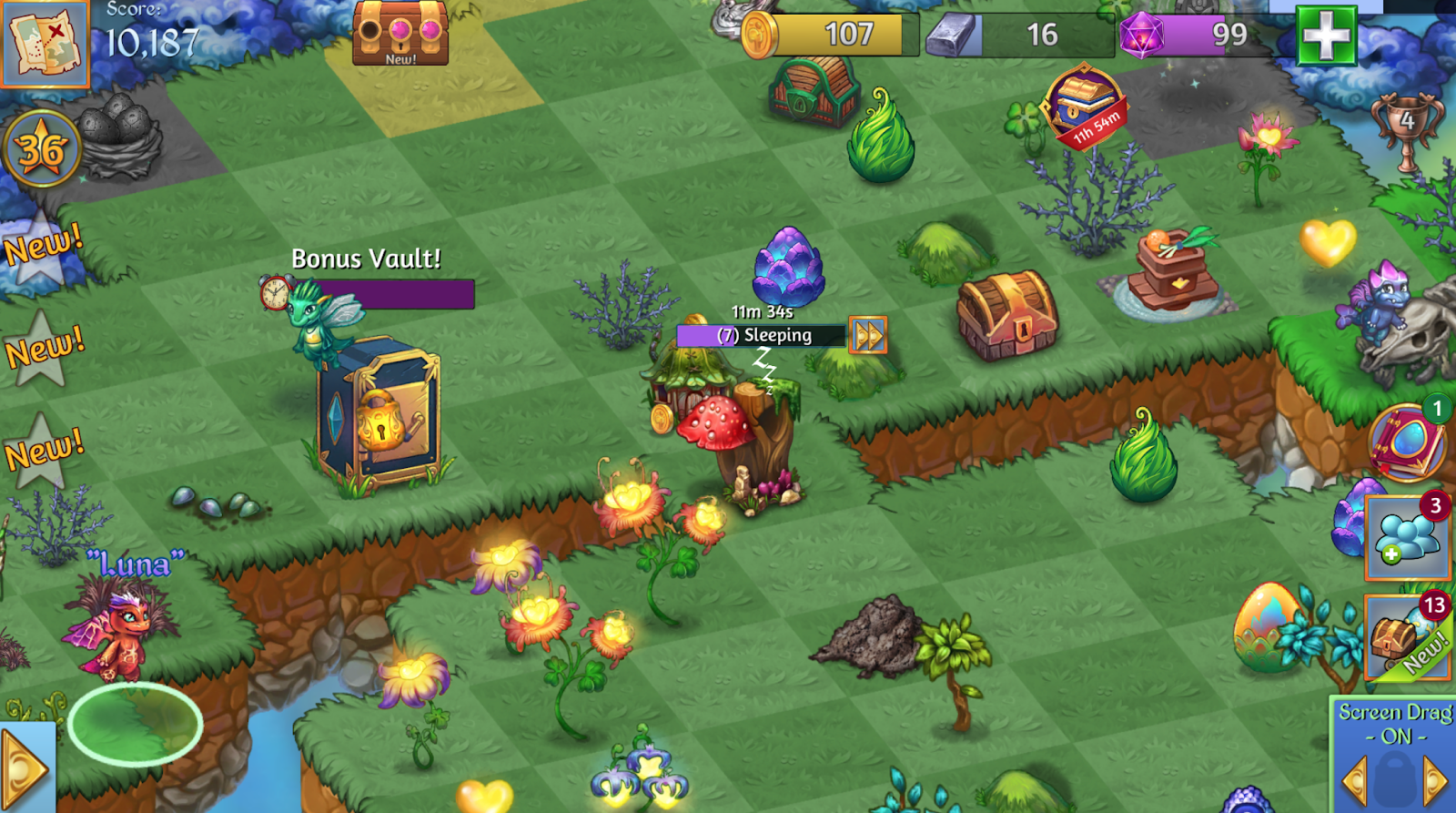
How Dragons work: A) Players earn/purchase Dragons and upgrade them; B) The Dragons begin doing actions to clean up the Player’s camp; and C) After doing a certain amount of actions, the Dragon will go into its home to sleep for several minutes. Just as you can break down minutes per action when it comes to Energy, you can also break down Minutes per action based on Dragon rest times.
The Cost and value of “Energy” (Dragons) in Merge Dragons is pretty easy for Players to figure out. The cost comes down to the amount of Dragons sleeping and how much longer they have left.

The value of “Energy” (Dragons) is also simple–Wake a Dragon and get X amount of actions before it sleeps again. Players can do the math to see what the value of their dollar is worth.
RPGs
Players in RPGs are all-too-used to seeing Energy as a limiting Mechanic. Star Wars: Galaxy of Heroes, for example, requires energy for Players to do a PvE Stage.

Just like the casual games I’ve discussed, the cost/value proposition of Energy in Star Wars: Galaxy of Heroes is pretty easy to determine. Hard Currency cost of an Energy Refill is clear when you try to refill energy, and the potential drops of PvE Stages is also pretty clear based on what Stage you use the Energy in.

Contrast this with an RPG like RAID:Shadow Legends, where Energy is necessary for almost every Event, and the value proposition of Energy becomes a lot harder to assess.

For when you spend Energy in RAID, you aren’t just getting the immediate rewards of the PvE content you are playing (like you do in SW: GOH), you are also making progress on a wide variety of Events and other systems like Battle Pass, Daily Quests, Missions, etc. When you factor the rewards of Events/Other Systems, it becomes difficult to know how much value you are getting from Energy except that you are getting more than what the Game tells you at first glance.
Combine this with RAID’s Energy-oriented Packs, and you get a scenario where Energy is super cheap and the value proposition is better than expected.
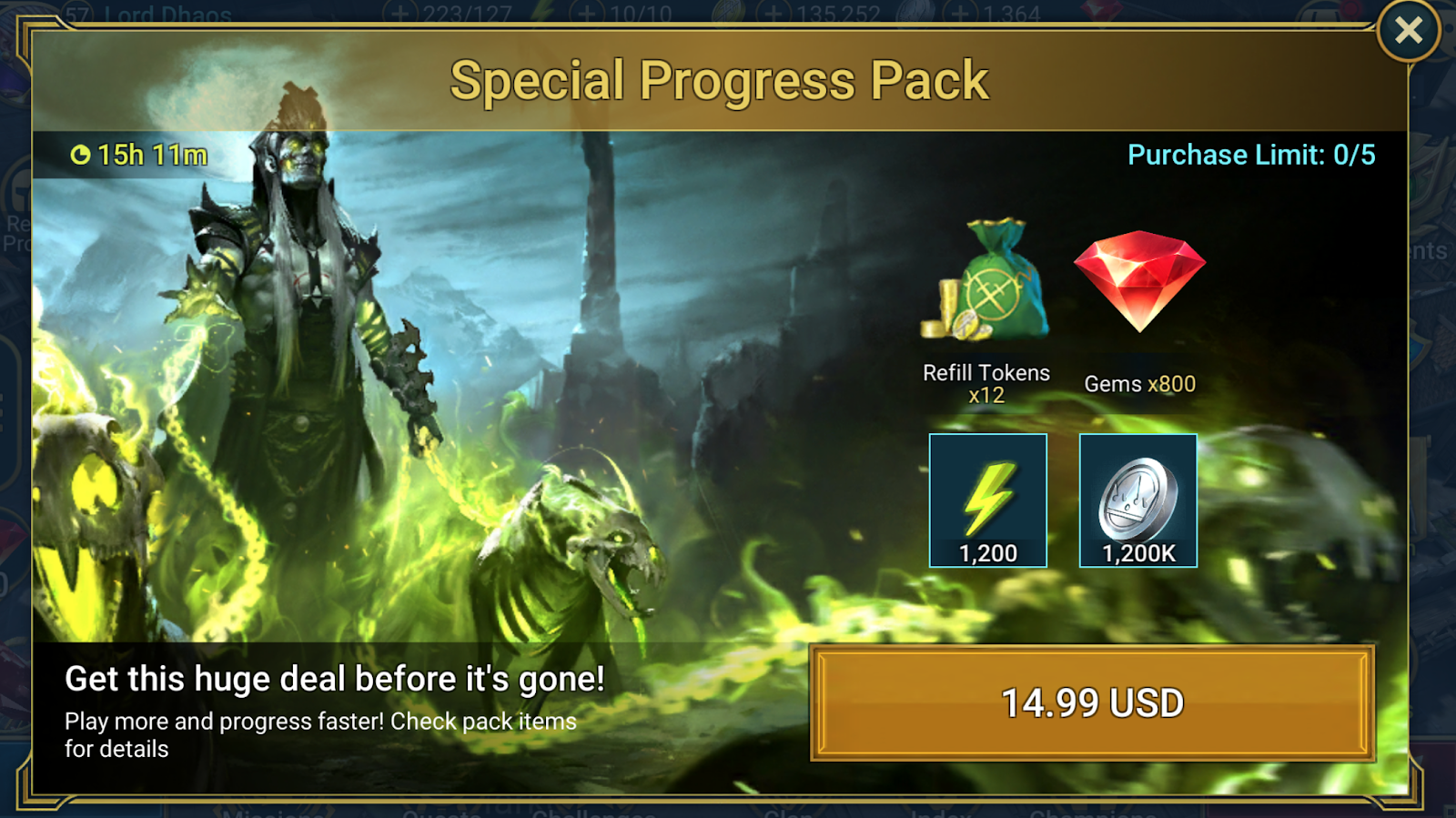
In this example of an Energy Pack, Players can get anywhere between 2620 Energy to 3800 Energy for $15. That Energy can go a long way and accomplish a TON. Compared with other Packs, the Energy Pack gives more bang for your buck as long as you have the time to spend all the Energy.
Strategy Games
Strategy Games typically don’t have Energy in the traditional sense. But they almost all have a limiting mechanic.
Clash Royale uses Chests to limit how much a Player can play without Spending.

Clash of Clans uses Army Troop Training Times and Hero Health Recovery Time to also Limit Player Gameplay.

Even 4x Games like Rise of Kingdoms uses travel times and army caps as a means of ensuring that Players cannot endlessly send off Armies without paying a cost.

Almost all games will have a Limiting Mechanic similar to Energy, if not Energy outright. If you are thinking about paying to get around the Limiting Mechanic (or purchase more Energy), make sure you get the most value for your dollar.
That’s it for me. Thank you for reading! Feel free to leave a comment or question. If you want to see more posts like this, please subscribe to ggDigest here: medium.com/ggdigest
Until next time! Stay safe!
Jeff
 Principles of Free to Play Game Design